From Detecting Defaults to Preventing Them
For decades, Early Warning Systems (EWS) in lending have been designed to answer one fundamental question:
Which borrowers are likely to default?
While that question remains important, today’s lending environment demands much more.
Businesses experience fluctuating cash flows, consumers exhibit changing financial behaviors, and macroeconomic events can alter repayment capacity almost overnight.
By the time traditional Early Warning Systems identify a problem, borrowers have often already missed payments, utilization has increased, or collections have begun.
The future of risk management isn’t simply about identifying defaults earlier.
It’s about identifying financial stress before it becomes credit risk.
This is where Agentic Decisioning fundamentally changes how lenders approach Early Warning Systems.
Why Traditional Early Warning Systems Fall Short
Most Early Warning Systems rely on predefined rules and periodic monitoring. They typically evaluate indicators such as:
- Days Past Due (DPD)
- EMI delays
- Bureau score changes
- Loan utilization
- Collection triggers
- Account status changes
These indicators remain valuable, but they all share one limitation:
They are reactive.
They explain what has already happened, not what is likely to happen next.
As a result, lenders often face:
- Late interventions
- Higher collection costs
- Increased NPAs
- Poor customer experience
- Missed restructuring opportunities
Financial Stress Appears Long Before Default
Long before a borrower misses an EMI, subtle financial signals begin to emerge.
For MSMEs
- Declining monthly revenues
- Increasing vendor payment delays
- Lower average bank balances
- Rising working capital utilization
- Cash flow volatility
- Irregular transaction patterns
For Retail Borrowers
- Reduced salary credits
- Increasing credit card utilization
- Frequent overdrafts
- Declining disposable income
- Irregular income deposits
- Higher EMI-to-income ratio
Individually, these signals may appear insignificant.
Together, they paint a clear picture of deteriorating financial health—one that traditional systems rarely connect.
The Real Challenge Isn’t Data
Most financial institutions already possess enormous amounts of customer data, including:
- Bank statements
- Financial statements
- GST data
- Bureau reports
- Loan origination systems
- Loan management systems
- Collections platforms
- CRM data
- Internal transaction history
The challenge isn’t data availability.
The challenge is converting fragmented financial information into continuous decision intelligence.
Enter Agentic Decisioning
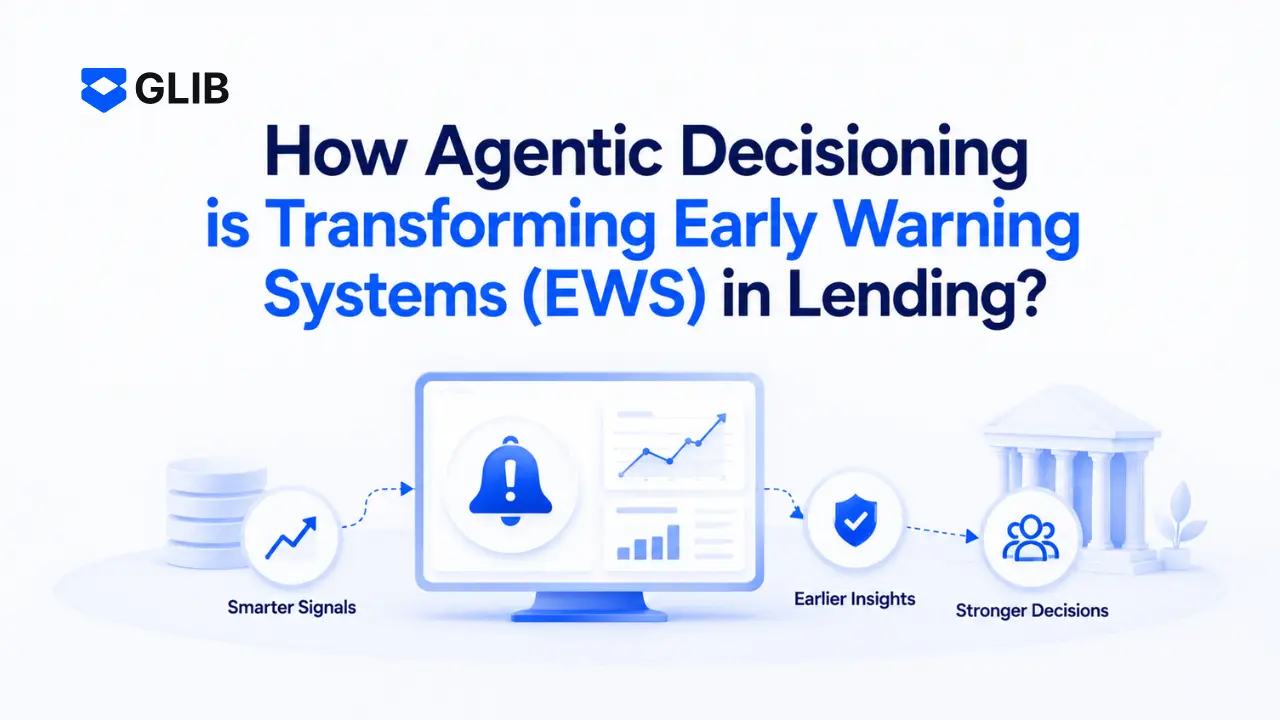
Agentic Decisioning transforms Early Warning Systems from static monitoring tools into intelligent decision engines.
Instead of running scheduled rule evaluations, AI agents continuously:
- Observe financial behavior
- Correlate multiple signals
- Reason about evolving risk
- Recommend the next best action
Instead of generating alerts like:
Customer missed an EMI.
An intelligent AI agent identifies:
Monthly inflows have declined for three consecutive months, cheque returns have doubled, liquidity ratios are deteriorating, and cash flow volatility suggests repayment stress within the next 45 days.
That’s the difference between reactive monitoring and proactive intelligence.
How GLIB Reinvents Early Warning Systems
GLIB’s Agentic Decisioning & Automation Platform continuously monitors borrower financial health using AI-powered agents.
Instead of relying on periodic reviews, GLIB continuously analyzes:
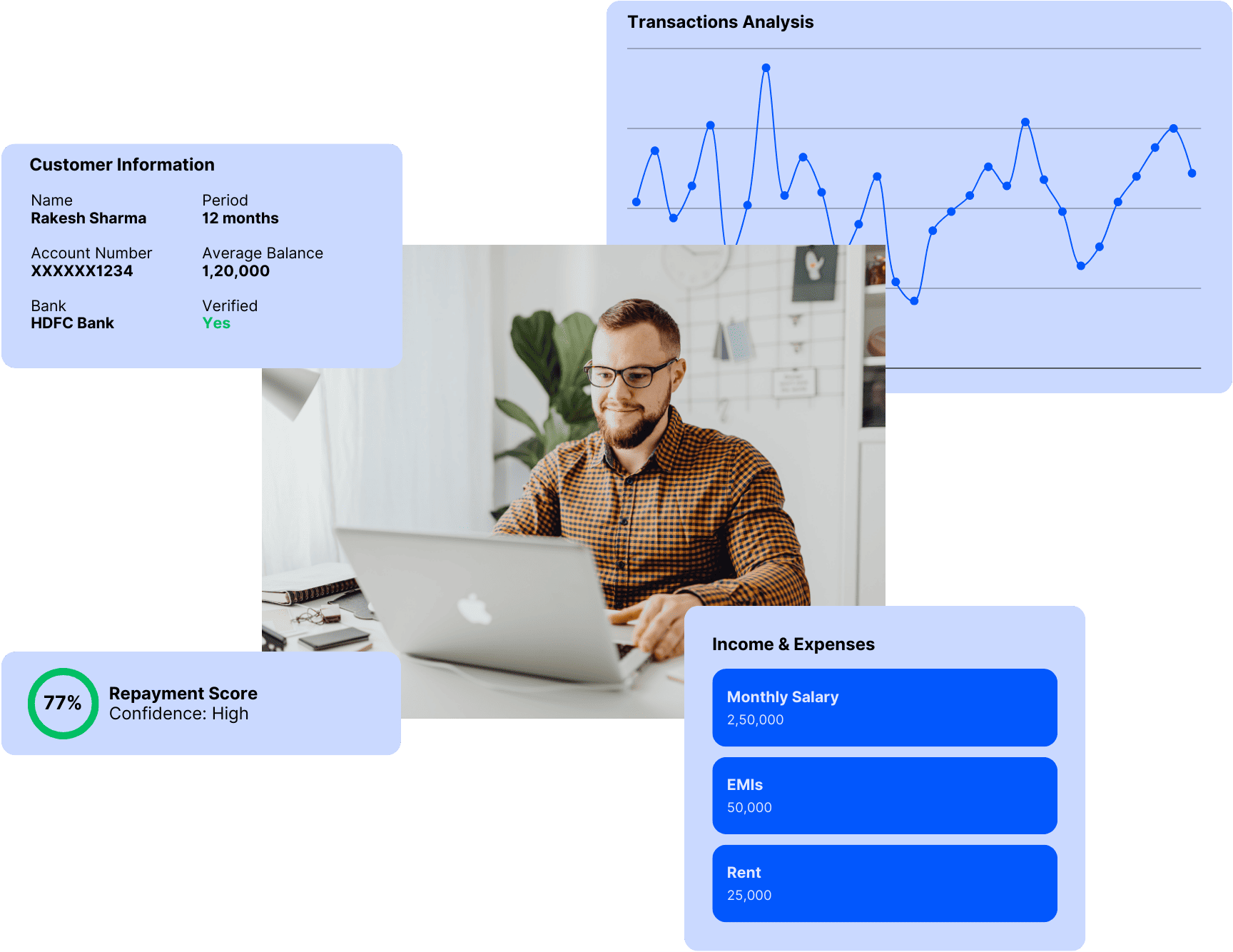
- Bank statement transactions
- Cash flow patterns
- Financial ratios
- Income consistency
- Expense trends
- Repayment behavior
- External financial data
- Policy thresholds
- Portfolio exposure
Every financial event contributes to a continuously evolving borrower risk profile.
AI-Powered Financial Intelligence
GLIB automatically extracts, validates, and understands financial information from:
- Bank statements
- Financial statements
- Income documents
- GST records
- Bureau reports
Rather than simply digitizing documents, GLIB transforms fragmented financial data into structured, decision-ready intelligence.
Continuous Borrower Monitoring
Instead of quarterly or monthly portfolio reviews, GLIB continuously evaluates:
- Cash flow deterioration
- Declining revenues
- Increasing liabilities
- Working capital stress
- Payment behavior
- Financial anomalies
The result is a dynamic borrower health score instead of outdated point-in-time assessments.
Intelligent Risk Reasoning
Traditional Early Warning Systems evaluate isolated rules.
GLIB’s AI agents evaluate context by correlating signals such as:
- Revenue decline
- Expense growth
- Delayed vendor payments
- Falling average bank balances
- Increasing debt obligations
Together, these indicators provide a far more accurate assessment of financial stress, reducing false positives while improving prediction accuracy.
Automated Decision Orchestration
Identifying risk is only the beginning.
Once potential stress is detected, GLIB automatically orchestrates downstream actions such as:
- Escalating high-risk accounts
- Triggering relationship manager reviews
- Initiating portfolio reassessments
- Recommending restructuring opportunities
- Updating internal risk scores
- Routing cases for manual approval
This eliminates manual coordination while ensuring timely intervention.
Traditional EWS vs Agentic Decisioning
| Traditional EWS | GLIB Agentic Decisioning |
|---|---|
| EMI missed | Stress detected weeks earlier |
| Reactive alerts | Continuous monitoring |
| Collections begin | Proactive customer engagement |
| Rule-based decisions | AI-driven reasoning |
| Static snapshots | Dynamic borrower health |
Example
Traditional EWS
The borrower misses an EMI.
An alert is generated.
Collections begin.
GLIB Agentic Decisioning
Weeks before default, GLIB identifies:
- Declining monthly credits
- Increasing vendor payments
- Irregular cash flows
- Falling bank balances
- Rising working capital utilization
- Deteriorating expense-to-income ratio
Instead of simply generating an alert, GLIB recommends:
- Customer engagement
- Portfolio review
- Enhanced monitoring
- Working capital reassessment
The result is proactive intervention instead of reactive collections.
Business Impact
Financial institutions adopting Agentic Decisioning can achieve:
Earlier Risk Identification
Identify financial stress weeks before conventional Early Warning Systems.
Better Portfolio Quality
Reduce delinquencies through proactive intervention.
Lower Collection Costs
Engage borrowers before accounts become overdue.
Improved Customer Experience
Support customers before financial stress escalates.
Smarter Credit Decisions
Continuously update borrower intelligence using real-time financial data.
Scalable Operations
Monitor thousands of borrowers simultaneously without increasing operational effort.
From Early Warning Systems to Early Intelligence Systems
The future of lending won’t be driven by dashboards alone.
It will be powered by autonomous AI agents capable of:
- Continuously observing financial behavior
- Understanding evolving borrower risk
- Correlating multiple financial signals
- Recommending intelligent actions
- Executing automated workflows
- Learning from historical outcomes
This is the evolution from automation to decision intelligence.
The GLIB Perspective
At GLIB, we believe the future of lending extends far beyond faster loan approvals.
True competitive advantage comes from enabling better decisions throughout the customer lifecycle.
GLIB’s Agentic Decisioning & Automation Platform combines:
- AI-powered document intelligence
- Financial data analysis
- Intelligent AI agents
- Workflow orchestration
- Explainable decisioning
- Continuous monitoring
Together, these capabilities enable lenders to move from reactive portfolio monitoring to proactive portfolio intelligence.
Because tomorrow’s leading financial institutions won’t simply process loans faster.
They’ll understand borrower risk earlier—and act on it intelligently.
Conclusion
Traditional Early Warning Systems were designed to identify problems.
Agentic Decisioning transforms them into systems that anticipate, reason, recommend, and orchestrate action.
For lenders navigating growing portfolio complexity, evolving regulations, and rising customer expectations, this shift is more than a technology upgrade.
It’s a strategic competitive advantage.
The future of Early Warning Systems isn’t about generating more alerts. It’s about enabling better decisions before risk becomes loss.
About GLIB
GLIB Agentic Decisioning & Automation Platform empowers financial institutions to transform fragmented financial data into intelligent, explainable, and automated decisions.
From AI-powered document intelligence and financial analysis to continuous borrower monitoring and workflow orchestration, GLIB helps lenders accelerate decisions, reduce risk, and build more resilient lending operations.