The Bank Statement Is Still the Centre of the Credit Decision
In Indian lending, very few documents carry as much weight as the bank statement.
A salary slip tells you what an employer says a borrower earns.
An ITR tells you what the borrower declared.
A bank statement shows you what actually happened: money coming in, money going out, and how the account behaves in between.
That’s why it sits at the centre of nearly every retail, MSME and personal loan decision in India. It’s also why reviewing it well is so hard.
Why Manual Review Doesn’t Scale in India
A credit team in India doesn’t deal with one bank statement format. It deals with hundreds.
An applicant may submit:
- A digitally generated PDF from SBI
- A password-protected e-statement from HDFC Bank
- A scanned passbook copy from a cooperative bank
- A screenshot-based statement downloaded from a mobile banking app
- Twelve months of ICICI Bank statements split across multiple files
Each one has a different layout, different column structures and different narration conventions.
On top of that, transaction narrations in India are dense and inconsistent. A single month can contain UPI transfers, NEFT and RTGS credits, IMPS payments, NACH debits, ECS mandates, cheque returns, ATM withdrawals and cash deposits, each described differently by each bank.
An underwriter reviewing this manually has to:
- Read every page
- Re-key figures into a spreadsheet
- Work out which credits are genuine income
- Identify existing EMIs and obligations
- Look for bounces, circular transactions and signs of manipulation
- Summarise it all into a credit view
Under deadline pressure, with a queue of files waiting, this is where time is lost and where errors quietly enter the decision.
The problem isn’t a lack of data. It’s that the data arrives unstructured, in inconsistent formats, at volume.
What AI-Powered Bank Statement Analysis Actually Does
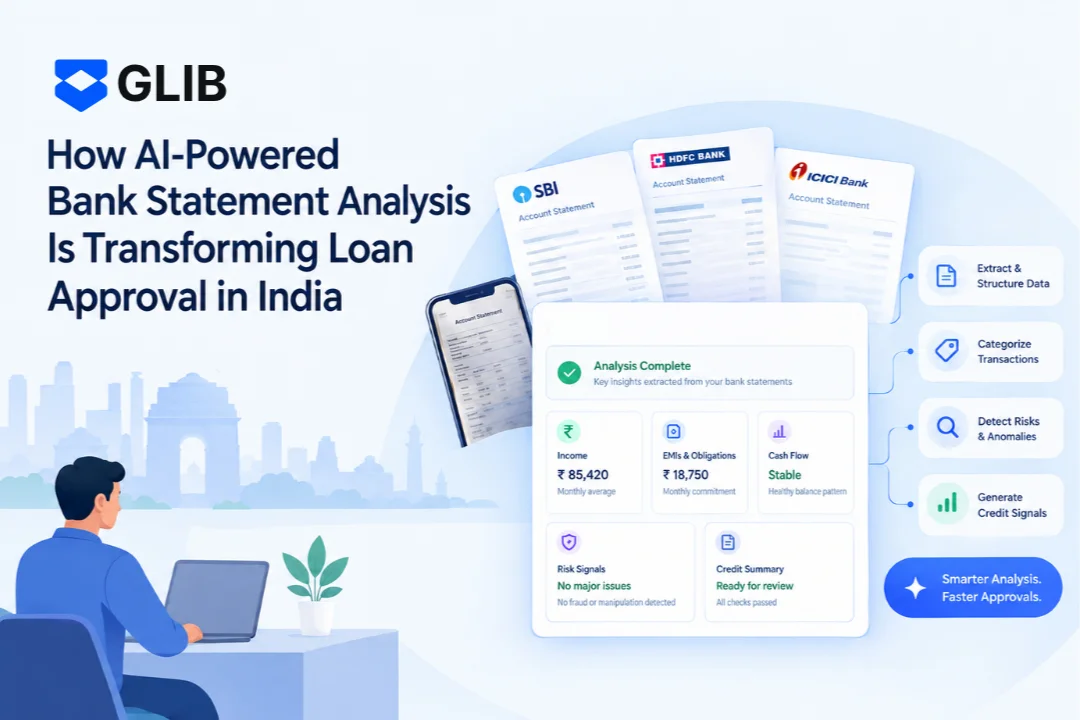
AI-powered analysis turns bank statements from static documents into structured, decision-ready evidence. The workflow typically moves through four stages.
1. Extract & Structure Data
The first step is reading the statement accurately, whatever its source.
AI models can parse digital PDFs, scanned documents and mobile-generated statements, identify the bank and account details, and convert every transaction into a structured record with date, narration, debit, credit and running balance.
Balance continuity checks confirm that nothing was missed or misread between pages.
2. Categorize Transactions
Once the data is structured, each transaction needs to be understood.
AI classifies transactions into meaningful categories such as:
- Salary and business income
- EMIs and loan repayments
- Rent, utilities and recurring bills
- Transfers between the applicant’s own accounts
- Cash deposits and withdrawals
- Investments, insurance and tax payments
This is where Indian narrations become manageable. Instead of an underwriter decoding UPI/CR/4012xxxx/RAMESH K/SBIN/... line by line, the system recognises the pattern and classifies it consistently.
3. Detect Risks & Anomalies
Structured, categorized data makes it possible to look for what a quick read would miss:
- Cheque and NACH bounces
- Round-figure cash deposits just before the statement date
- Circular transactions between related accounts
- Sudden spikes in credits that don’t match the stated income
- Irregular salary credits or changes in employer
- Font, layout or balance inconsistencies that may point to a tampered statement
Each flag comes with the transactions behind it, so the credit team can see why something was raised, not just that it was.
4. Generate Credit Signals
Finally, the analysis is summarised into the signals a credit decision depends on:
| Signal | What it tells the lender |
|---|---|
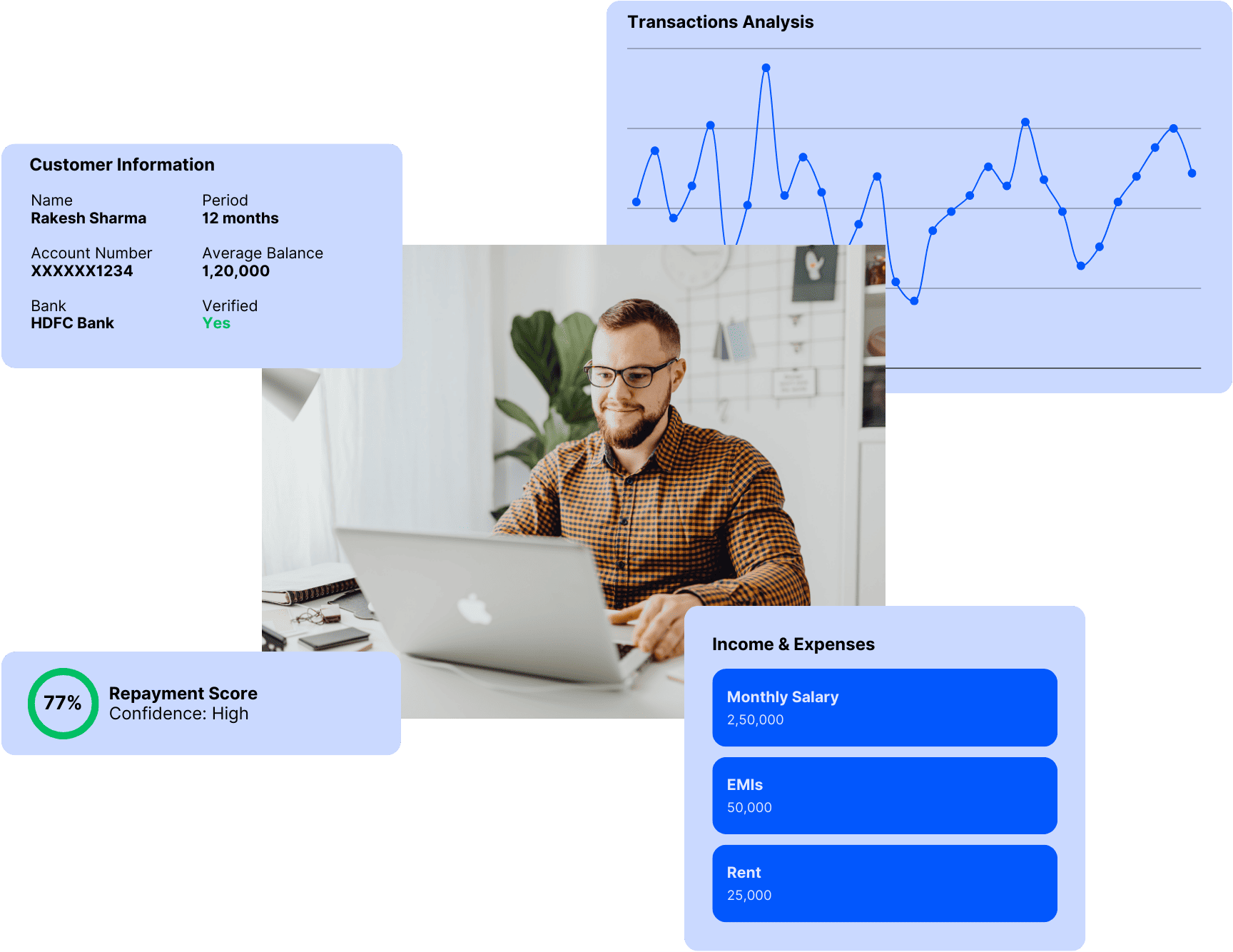
| Income | Monthly average of verified income credits |
| EMIs & Obligations | Existing monthly commitments, including loans not declared in the application |
| Cash Flow | Whether the account shows a stable, healthy balance pattern |
| Risk Signals | Any fraud, manipulation or behavioural red flags |
| Credit Summary | A consolidated view, ready for underwriter review |
What once took an analyst hours becomes a structured report available within minutes.
What Changes for Indian Lenders
Faster Turnaround Times
Borrowers in India increasingly expect digital, near-instant loan journeys. When statement analysis takes minutes rather than hours or days, lenders can sanction faster without cutting corners.
More Consistent Decisions
Two underwriters reviewing the same statement manually may reach different conclusions. AI applies the same categorization and risk logic to every file, giving credit teams a consistent baseline to work from.
Better Fraud Detection
Statement tampering and income inflation are persistent problems in Indian retail and MSME lending. Automated checks across every transaction and every page catch patterns that are easy to miss on a manual skim.
Reaching New-to-Credit Borrowers
A large share of India’s borrowers have thin or no bureau history. For self-employed individuals, gig workers and small businesses, the bank statement is often the most reliable evidence of repayment capacity. Structured cash-flow analysis helps lenders assess these borrowers with more confidence.
Scale Without Proportional Headcount
As application volumes grow, manual review requires more analysts. Automated analysis lets the same credit team handle significantly more files, focusing their expertise on the exceptions that actually need judgement.
From Document Review to Decision Intelligence
The shift can be summarised as:
| Manual Review | AI-Powered Analysis |
|---|---|
| Hours per file | Minutes per file |
| Re-keying into spreadsheets | Automatic extraction and structuring |
| Format-by-format handling | Works across banks and formats |
| Spot checks for fraud | Every transaction checked |
| Subjective categorization | Consistent categorization |
| Conclusions without evidence trail | Evidence-backed credit signals |
This doesn’t remove the underwriter from the decision.
It changes what the underwriter spends time on: less reading and re-typing, more judgement.
How GLIB Helps
GLIB’s Bank Statement Analyzer is built for the realities of Indian lending. It processes statements across banks and formats, categorizes transactions, flags risks and anomalies, and produces credit-ready summaries that plug directly into underwriting workflows.
As part of GLIB’s Agentic Decisioning & Automation Platform, bank statement insights can also be combined with other documents, such as KYC, ITRs, GST returns and financial statements, so that credit decisions are based on connected evidence rather than isolated documents.
The result is simple:
Smarter analysis. Faster approvals.
The Future of Loan Approval in India
India’s lending market is growing quickly, and borrower expectations are rising with it.
The lenders who lead will be the ones who can make fast decisions and well-evidenced ones.
AI-powered bank statement analysis makes that possible by turning one of the most important documents in the credit file into structured, reliable and actionable intelligence.
Because in lending, the story is already in the statement.
The question is how quickly, and how accurately, you can read it.