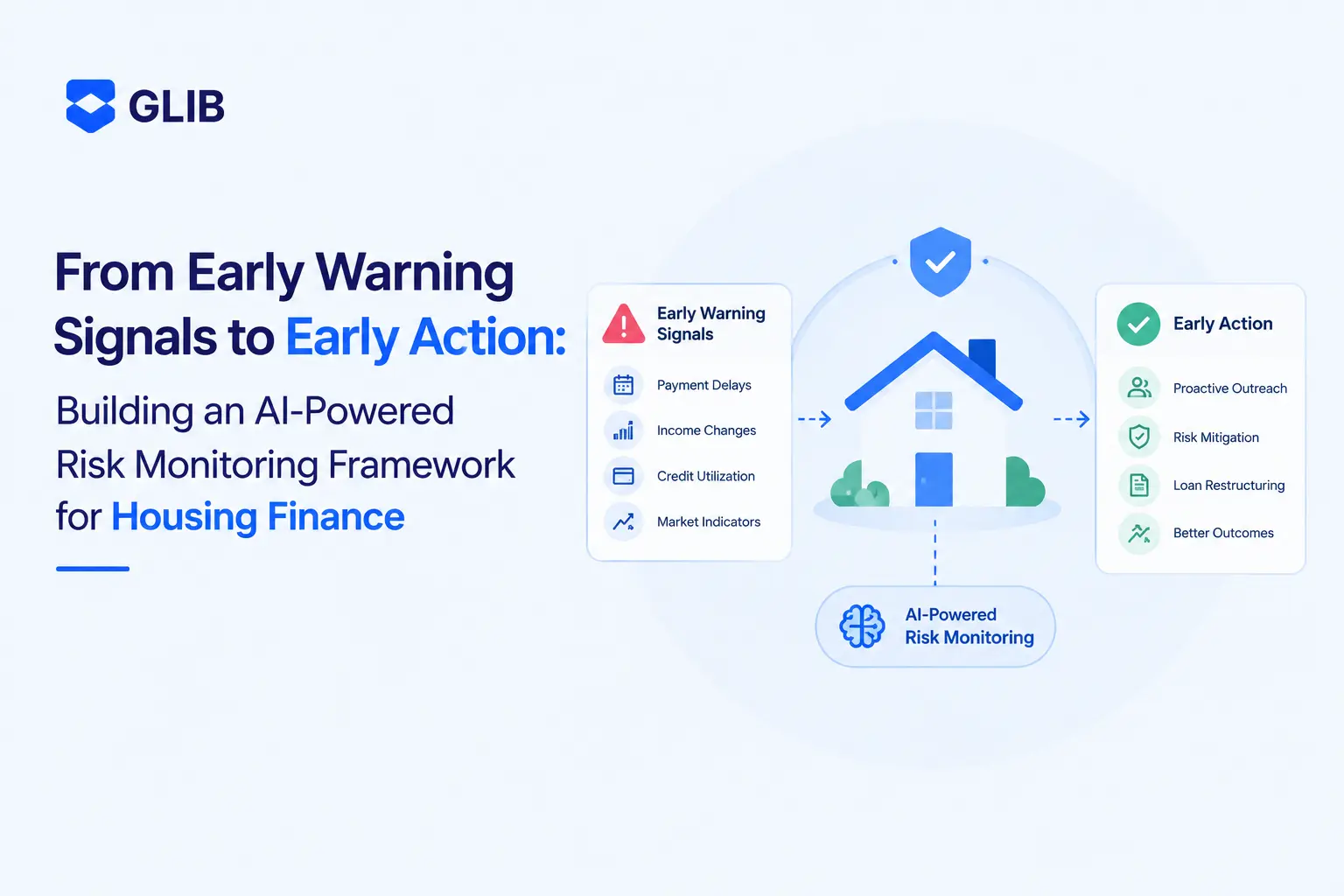
The Risk Doesn’t Begin When the EMI Bounces
In housing finance, a stressed account is rarely the result of a single event.
A borrower may have changed employment. A property may have encountered construction delays. A title document may remain unresolved. A valuation may have changed. Multiple loans may have been sanctioned within the same family. Repayment behaviour may begin deteriorating.
Individually, these may look like isolated exceptions.
Together, they can form a pattern.
This is the fundamental challenge behind Early Warning Signals (EWS) in housing finance: identifying meaningful signals early enough to enable investigation and action.
The National Housing Bank (NHB), in its Early Warning Signals Framework in HFCs circular dated April 26, 2023, highlighted deficiencies associated with reported frauds, including seller impersonation, fake income or employment documents, fake title deeds and builder-borrower collusion. The circular also noted that some deficiencies were identified only after borrowers stopped paying EMIs following loan disbursement.
NHB therefore called for an EWS framework that could trigger alerts before an account becomes an NPA or is declared fraudulent, with EWS tracking integrated into the HFC’s credit monitoring process as a continuous activity.
The implication is significant:
EWS cannot simply be another checklist sitting alongside the lending process. It needs to become part of the intelligence layer around the loan lifecycle.
What Does an Early Warning Signal Look Like in Housing Finance?
The NHB advisory provides an indicative list of EWS indicators for retail loans.
These cover significantly more than repayment behaviour.
They include:
- Incomplete pre-disbursement conditions
- Missing documents prescribed in legal or valuation reports
- Changes in borrower occupation
- Adverse developments in the borrower’s employment sector
- Construction not progressing according to schedule
- Delays in post-disbursement documentation
- Difficulty contacting the borrower
- Other lenders reporting NPA or fraud in the same project
- Waiver of KYC requirements
- DSA-level NPA or fraud patterns
- Title or collateral disputes
- Concealment of loan-related information
- Persistent SMA-2 status
- Balance transfer proposals with additional borrowing
- Cash-based EMI servicing
- Repeated NACH/PDC bounces
- Multiple loans among family members
- Abrupt changes in property value
- Delayed CERSAI/MCA charge creation
- Loans granted without required builder/developer NOC
This list demonstrates an important characteristic of housing-loan risk:
Risk is distributed across data.
It doesn’t necessarily reside inside the core lending system.
It can exist within documents, borrower information, property records, repayment data, sourcing channels and credit-monitoring systems.
That creates a technology challenge.
The Data Fragmentation Problem
Consider a hypothetical housing-loan account.
At origination:
KYC documents appear complete.
The income documents support the declared income.
The property documents pass initial review.
The loan is sanctioned and eventually disbursed.
Several months later:
- The borrower’s occupation changes.
- Construction progress is slower than expected.
- A post-disbursement document remains outstanding.
- The borrower starts servicing EMIs through cash.
- NACH has bounced multiple times.
Each event may be captured by a different process.
The KYC team sees one piece.
The property-monitoring team sees another.
The collections team sees another.
The credit-monitoring team sees another.
The challenge is therefore not merely data availability.
It is data connectivity and contextualisation.
From Rule-Based Checks to Connected Risk Intelligence
Traditional EWS implementations can rely heavily on predefined rules.
For example:
If NACH bounces exceed a defined threshold → generate an alert.
This is useful.
But consider a more contextual scenario:
NACH bounces + change in occupation + unresolved documentation + construction delay
The value comes not just from detecting four individual events, but from bringing them together for investigation.
This creates a three-layer architecture for intelligent EWS.
Layer 1: Signal Detection
Identify events, exceptions, anomalies and missing information.
Layer 2: Signal Context
Connect signals across the borrower, property, loan, project and repayment lifecycle.
Layer 3: Action Orchestration
Route the relevant evidence and alerts to the appropriate workflow, team or escalation path.
The objective isn’t necessarily to automate every risk decision.
It is to make sure that the right signal reaches the right person with the right evidence at the right time.
Where AI Can Strengthen the EWS Architecture
AI can contribute to EWS in several parts of the housing-finance lifecycle.
1. Document Intelligence
Housing loans generate substantial documentation across origination and servicing.
AI-powered document intelligence can help extract and structure information from documents such as:
- KYC documents
- Income documents
- Bank statements
- Property documents
- Legal reports
- Valuation reports
- Builder documentation
Instead of treating documents as static files, the information within them can become structured inputs into downstream workflows.
2. Financial Intelligence
Bank statements and financial documents contain signals that may not be obvious from a simple document review.
AI can help structure financial information and identify relevant patterns for further analysis.
This becomes particularly valuable when financial evidence needs to be evaluated alongside other borrower information.
3. Anomaly and Exception Detection
A rules engine can identify predefined conditions.
AI can complement this by helping analyse unstructured information and surface inconsistencies or anomalies that require investigation.
For example:
Declared information
versus
Information appearing across supporting documents
can be compared within a defined workflow.
The resulting output can become an input to an EWS process rather than a standalone document-review result.
4. Cross-Document Intelligence
This is where the architecture becomes particularly relevant for housing finance.
Imagine information extracted from:
KYC → Income → Bank Statement → Property → Legal → Valuation
Instead of analysing every document independently, an intelligent platform can make the structured outputs available to downstream workflows.
This creates a connected evidence layer.
Fragmented approach
Document A → Review
Document B → Review
Document C → Review
Connected approach
Documents → Structured Evidence → Cross-document Analysis → Risk Signals
The distinction is important.
Document intelligence tells you what’s inside the document.
Decisioning intelligence helps determine how that information should participate in a business workflow.
5. Workflow Orchestration
An EWS is only useful when a signal leads to an appropriate next step.
For example:
This is where workflow orchestration becomes critical.
NHB’s framework specifically calls for EWS tracking to be integrated with the credit monitoring process as a continuous activity.
Therefore, the technology architecture should not treat EWS as an isolated analytics dashboard.
It should be connected to the operational process.
What an AI-Powered Housing Finance EWS Architecture Could Look Like
A conceptual architecture can be represented as:
The important principle is that AI should augment the monitoring process rather than operate as a black-box replacement for risk governance.
Beyond Retail Loans
The NHB advisory also identifies EWS indicators for Corporate/Project Loans.
These include:
- Restructuring requests
- Promoter stake reductions
- Legal proceedings and penalties
- Construction delays
- Additional credit sought to repay existing loans
- Management changes
- Substantial related-party transactions
- Discrepancies in annual reports
- Non-routing of receipts through designated escrow accounts
This broadens the opportunity beyond individual home loans.
An intelligent EWS architecture can potentially support:
- Retail Housing Loans
- Construction Finance
- Builder/Project Monitoring
- Corporate Borrower Monitoring
- Portfolio Risk Monitoring
The common requirement is the same:
Bring fragmented evidence together and turn it into actionable intelligence.
From EWS Checklist to Continuous Intelligence
The next evolution of housing-finance risk monitoring is not necessarily about generating more alerts.
It is about generating more meaningful context around the alerts that matter.
The shift can be summarised as:
| Traditional EWS | Intelligent EWS |
|---|---|
| Periodic monitoring | Continuous monitoring |
| Isolated signals | Connected signals |
| Document-by-document review | Cross-document intelligence |
| Static rules | Rules + AI-assisted analysis |
| Alerts without context | Evidence-backed alerts |
| Manual routing | Workflow orchestration |
| Reactive investigation | Earlier investigation |
This doesn’t eliminate the role of credit, risk or operations teams.
It changes the information available to them.
How GLIB Fits Into the EWS Journey
GLIB’s Agentic Decisioning & Automation Platform brings together document intelligence, financial intelligence, AI agents and workflow orchestration.
For housing finance, this architecture can be applied across stages such as:
Origination
Analyse and structure borrower and property documentation.
Underwriting
Bring financial and documentary evidence into decisioning workflows.
Fraud & Risk
Surface relevant anomalies and potential risk indicators.
Post-Disbursement Monitoring
Continuously evaluate defined signals across the loan lifecycle.
Credit Monitoring
Route relevant signals, evidence and exceptions into monitoring workflows.
The underlying principle is simple:
Don’t wait for the risk event. Look for the signals that precede it.
The Future of Housing Finance Risk Management
The NHB framework provides HFCs with an important foundation: identify relevant warning signals and integrate their tracking into continuous credit monitoring.
The technology opportunity is to make that process more connected.
When documents, financial information, borrower behaviour, property information and repayment signals can participate in a common intelligence layer, HFCs can move from simply recording exceptions toward understanding patterns.
Because the most valuable risk signal may not be the one that arrives last.
It may be the one that appeared much earlier—but was never connected to the others.
Source
National Housing Bank, NHB(ND)/DOS/Sup. Circular No. 9/2022-23, Department of Supervision, April 26, 2023.
The EWS indicators referenced in this article are based on the indicative list in the NHB advisory. HFCs were advised to add indicators based on their own experience.