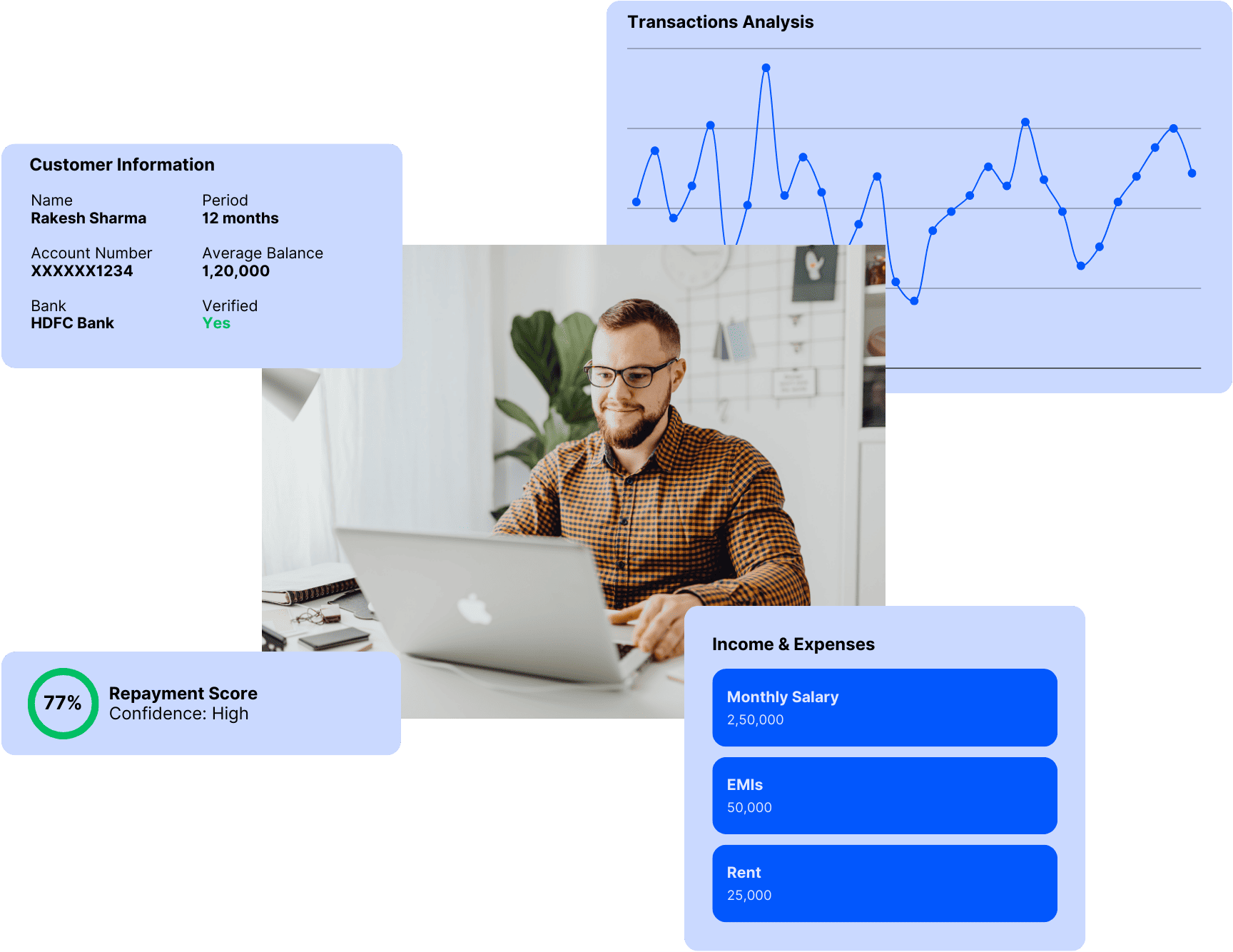
In today’s competitive lending landscape, traditional manual methods for assessing borrower financials are no longer adequate. Banks, NBFCs, and fintech lenders face mounting pressure to process loan applications faster, more accurately, and with stronger fraud detection and compliance capabilities. This is where AI-powered bank statement analysis becomes a game-changer — enabling real-time financial intelligence that fuels smarter credit underwriting decisions.
In this article, we’ll explore how this technology works, what a modern process architecture looks like, and how GLIB Document AI elevates the loan underwriting process with precision, speed, and compliance.
Why Bank Statement Analysis Matters in Underwriting
A borrower’s bank statement is one of the richest sources of real financial behavior — reflecting income, spending patterns, cash flow health, irregular deposits, loan EMIs, and possible fraud. Underwriters traditionally review these manually, a process that:
- Is time-consuming and error-prone
- Limits throughput, especially during high volumes
- Makes fraud and forgery hard to detect reliably
- Struggles to deliver consistent risk assessments
Modern AI changes the equation by automating extraction, interpretation, and risk scoring directly from raw bank statements.
The Core Architecture of AI-Powered Bank Statement Analysis
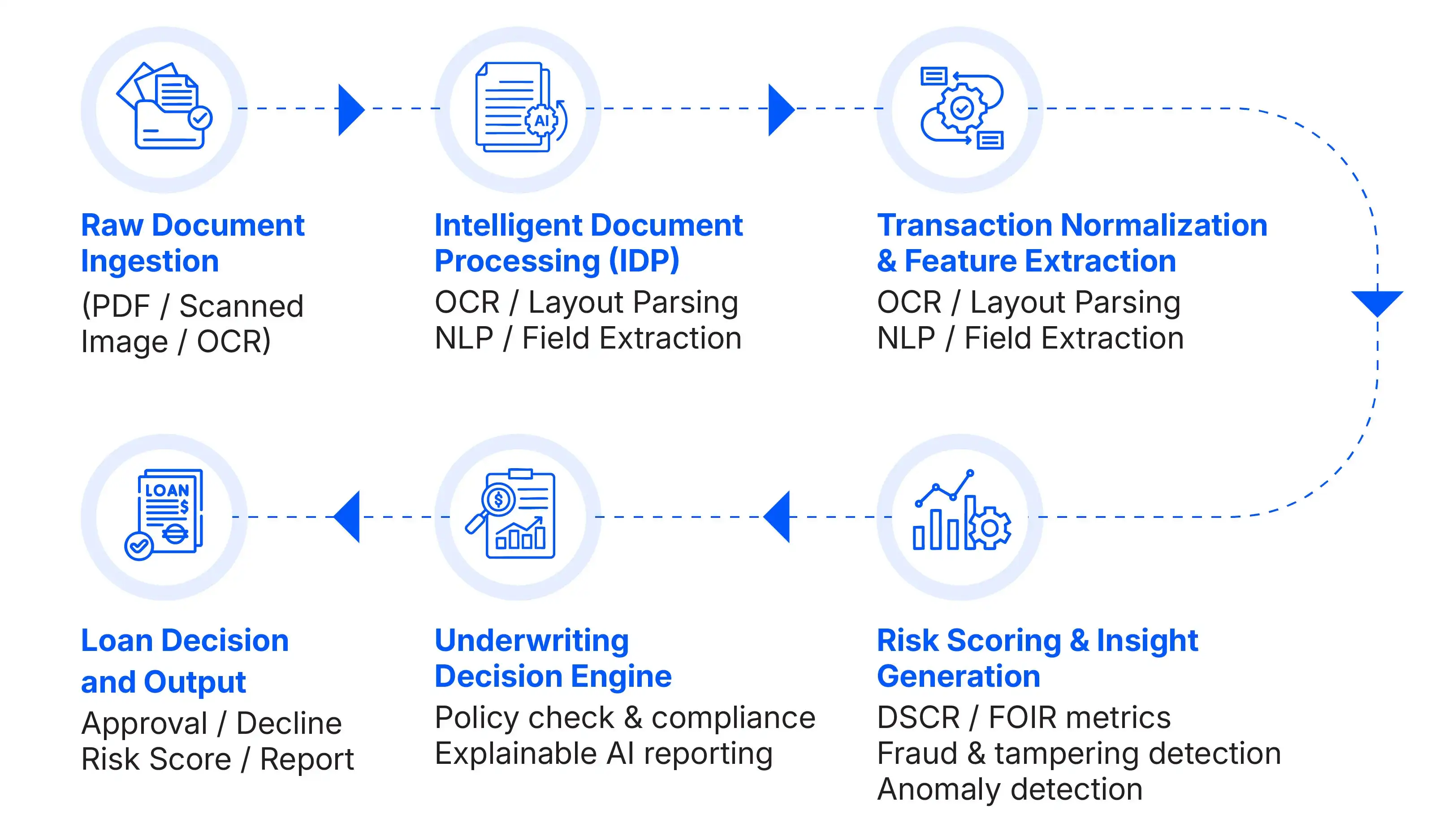
AI-powered bank statement analysis is built on a layered architecture that transforms unstructured financial documents into high-confidence, decision-ready intelligence. Unlike traditional rule-based systems that rely on fixed templates, this architecture is designed to handle wide variability in bank formats, transaction narratives, and data quality. It combines intelligent document processing, machine learning, and financial analytics into a continuous pipeline that not only extracts data but also understands financial behavior in context.
At the foundation lies a robust ingestion and document intelligence layer capable of processing scanned images, PDFs, and digitally generated statements across multiple banks. This raw data is then normalized and enriched using AI models that identify transaction types, recurring patterns, income sources, and liabilities. On top of this structured financial layer, advanced risk and anomaly detection models evaluate cash-flow stability, obligation burden, and potential fraud signals. The output is a set of explainable, policy-aligned insights that feed directly into underwriting decision engines — enabling lenders to move from manual scrutiny to automated, transparent, and scalable credit assessment.
Key AI Techniques Used
-
Optical Character Recognition (OCR) + Document Parsing
Advanced OCR extracts text from unstructured PDFs and images including multi-bank formats and handwritten data. Intelligent Document Processing (IDP) categorizes fields like balances, dates, and transaction descriptions. -
Natural Language Processing (NLP)
NLP identifies context — recognizing salaries, recurring EMIs, merchant descriptions, and other financial signals rather than just raw numbers. -
Machine Learning & Statistical Models
These analyze historical patterns to:- Validate income stability
- Detect anomalies or tampered documents
- Calculate cash flow indicators like FOIR (Fixed Obligation to Income Ratio) and DSCR (Debt Service Coverage Ratio)
- Provide explainable risk scores for compliance and audit trails
How GLIB Document AI Helps in Credit Underwriting
GLIB Document AI integrates all the above into a cohesive and scalable platform tailored for lending workflows. Here’s how it elevates underwriting:
-
AI-Driven Extraction & Classification
GLIB’s IDP engine automatically pulls structured data from bank statements, payslips, ITRs, and other borrower documents — reducing manual work and errors. - Multi-Account & Contextual Analysis
It combines transaction data across accounts, identifying:- Income streams
- Expense classifications
- Cash flow trends
- Related party transfers
This gives underwriters a holistic borrower picture.
-
Fraud Detection & Tamper Flags
AI models can spot forged PDFs, inconsistent transaction patterns, duplicate entries, and outliers that traditional rules might miss — critical for reducing default risk. -
Compliance & Explainability
GLIB ensures every decision is auditable and explainable, meeting regulatory guidelines (e.g., RBI, AML/KYC) and internal policy checks. - Seamless Integration
Its API-first architecture plugs into existing systems like Loan Origination Systems (LOS), Core Banking, CRM, and analytics dashboards with minimal disruption.
The Underwriting Process with GLIB
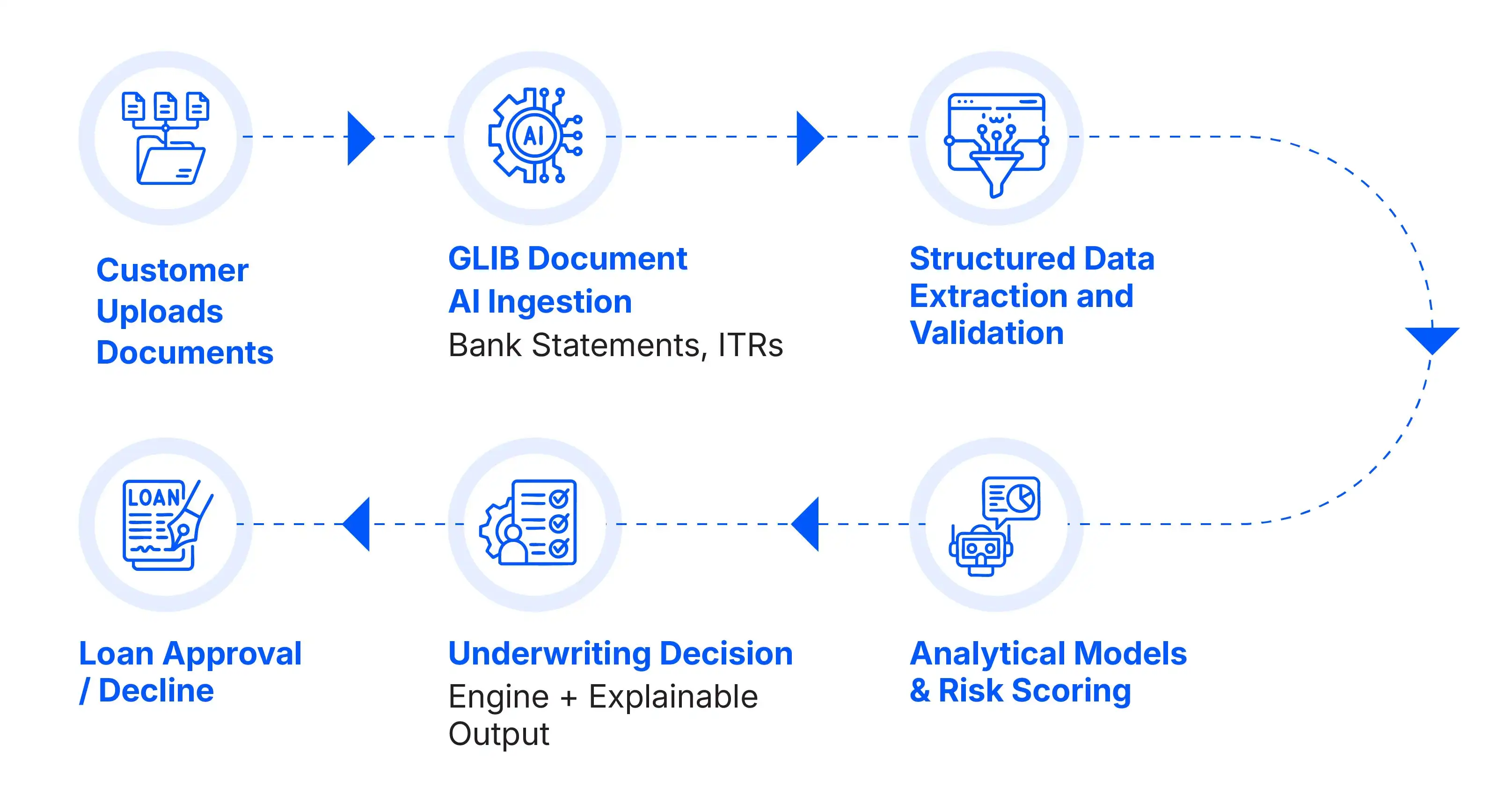
In a traditional underwriting setup, credit teams manually review bank statements, reconcile transactions, calculate ratios, and validate documents across multiple systems — often leading to delays, inconsistencies, and higher operational risk. GLIB re-architects this workflow into a unified, AI-driven underwriting pipeline, where document ingestion, financial analysis, risk assessment, and decision support happen seamlessly and in near real time.
Once a borrower uploads financial documents, GLIB’s Document AI automatically interprets unstructured bank statements across formats and institutions, validates their authenticity, and converts them into structured financial intelligence. This intelligence is then enriched with contextual insights such as income stability, obligation patterns, cash-flow health, and behavioral anomalies. Instead of static reports, underwriters receive policy-ready, explainable insights that integrate directly into Loan Origination Systems (LOS), enabling faster approvals, better risk differentiation, and stronger regulatory compliance-without increasing manual effort.
Conclusion
AI-powered bank statement analysis represents a hidden edge in modern underwriting, turning raw financial data into actionable insights that empower lenders to make faster, more reliable, and compliant credit decisions. Platforms like GLIB Document AI exemplify this shift by combining intelligent document processing, fraud detection, risk scoring, and explainable AI into a unified workflow. Financial institutions that adopt these technologies stand to significantly enhance underwriting quality while reducing costs and improving turnaround times.