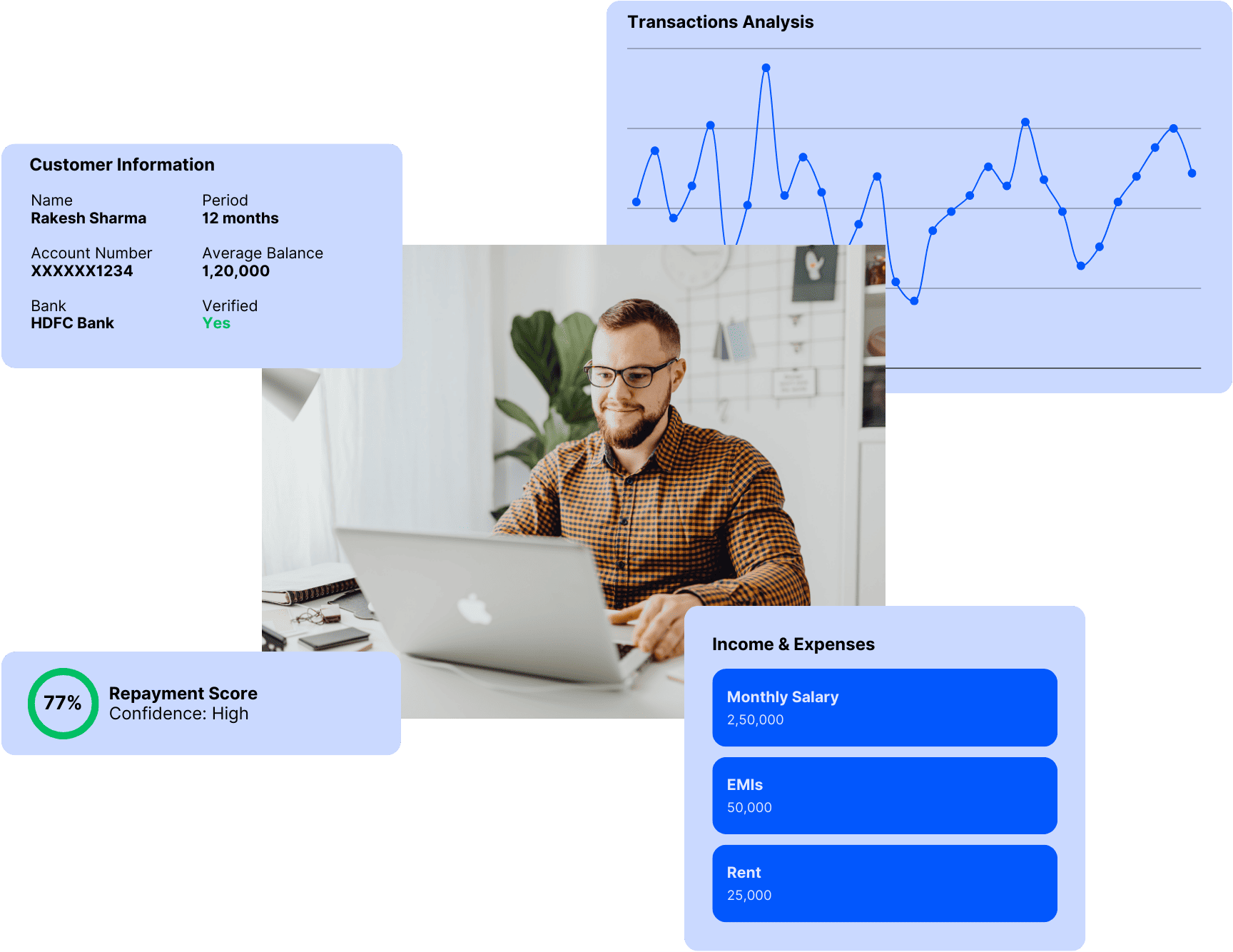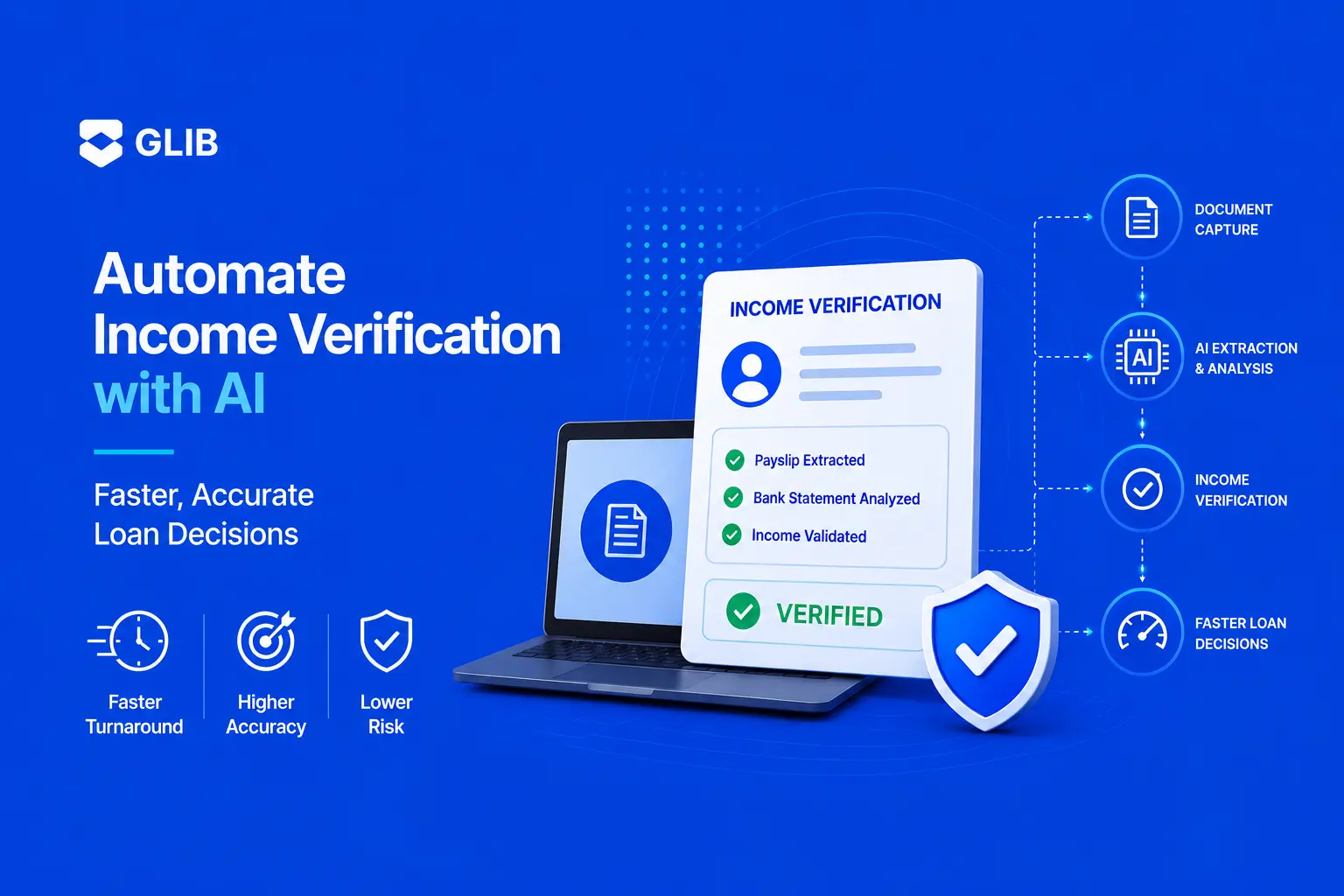
Income verification is a critical step in lending, underwriting, and financial decision-making. Yet, for many financial institutions, it remains one of the most time-consuming and error-prone processes.
Traditionally, analysts manually review bank statements, salary slips, and financial documents to assess borrower income. This approach slows down loan approvals, increases operational costs, and introduces inconsistencies.
Income verification automation powered by AI is transforming this process by enabling faster, more accurate, and scalable analysis of financial data.
Challenges in Manual Income Verification
Despite its importance, income verification is often handled through fragmented and manual workflows. This creates inefficiencies and introduces risk, especially when processing high volumes of applications.
These challenges directly impact turnaround time, operational costs, and decision accuracy.
Common challenges include:
- Time-consuming verification requiring manual document review
- High error rates due to manual data entry
- Difficulty detecting fraud or edited documents
- Limited scalability as application volumes grow
What is Income Verification Automation?
Income verification automation uses AI and intelligent document processing (IDP) to extract, analyze, and validate income data from financial documents such as:
- Bank statements
- Payslips
- Tax records
Instead of manually reviewing documents, the system processes data instantly and delivers structured insights that can be used for decision-making.
How AI Automates Income Verification
AI brings structure and intelligence to the verification process by standardizing how documents are processed and analyzed. This ensures consistency and eliminates dependency on manual effort.
The process typically includes:
- Document ingestion from multiple sources
- Data extraction of key financial fields like salary credits
- Income analysis to identify recurring and irregular income
- Validation to detect anomalies and inconsistencies
End-to-End Income Verification Automation Workflow
Income verification automation is most effective when implemented as a structured, end-to-end workflow.
Instead of isolated tools, leading lenders use integrated systems that handle everything from document ingestion to decision-ready insights.
Here’s how a modern AI-driven workflow looks:
Step 1: Document Collection & Ingestion
Borrowers upload bank statements, payslips, or financial documents via digital channels.
The system standardizes inputs across formats such as:
- PDFs
- Scans
- Images
Step 2: Intelligent Data Extraction
AI extracts key income-related fields such as:
- Salary credits
- Employer identifiers
- Transaction metadata
This converts unstructured documents into structured datasets.
Step 3: Income Classification & Normalization
The system categorizes income into:
- Fixed salary
- Variable income
- Business income
It also normalizes data for consistent analysis.
Step 4: Income Pattern Analysis
AI evaluates:
- Income consistency
- Frequency of deposits
- Variations over time
This helps assess financial stability.
Step 5: Fraud Detection & Validation
Advanced models flag:
- Edited PDFs
- Suspicious transaction patterns
- Mismatched data across documents
Step 6: Decision-Ready Output
Structured insights are generated and pushed into underwriting systems for faster decisions.
Benefits of Income Verification Automation
Automation does more than improve speed — it fundamentally enhances how financial institutions assess borrower income.
By reducing manual effort and improving accuracy, organizations can make faster and more reliable decisions.
Key benefits include:
- Faster loan approvals and reduced turnaround time
- Improved accuracy with minimal human intervention
- Enhanced fraud detection capabilities
- Scalability without increasing operational costs
Must Do and Must Not Do in Income Verification Automation
Must Do
A successful automation strategy requires more than just implementing technology — it requires the right approach and safeguards.
Best practices include:
- Use structured data extraction instead of raw OCR
- Validate income across multiple documents
- Implement AI-driven fraud detection
- Integrate outputs into underwriting systems
Must Not Do
Avoiding common mistakes is just as important as following best practices.
Common pitfalls include:
- Relying only on OCR without context
- Ignoring data standardization
- Skipping exception handling
- Overlooking compliance requirements
How GLIB Helps with Income Verification Automation
GLIB provides an AI-powered platform designed specifically to automate income verification workflows for financial institutions.
Instead of relying on manual review, GLIB enables end-to-end automation of financial document analysis with high accuracy and speed.
Key Capabilities
- Automated bank statement analysis to identify income patterns
- Income classification across salary, business, and irregular deposits
- Built-in fraud detection for anomalies and inconsistencies
- Structured outputs ready for underwriting systems
Business Impact
With GLIB, lenders can:
- Reduce processing time
- Improve decision accuracy
- Scale operations without increasing costs
Conclusion
Income verification automation is no longer optional for modern lenders.
As competition increases and customer expectations evolve, organizations must adopt AI-driven solutions to stay efficient and competitive.
Modern AI systems can:
- Analyze bank statements in seconds
- Identify recurring income patterns
- Distinguish salary credits from irregular cash flows
- Detect anomalies that manual reviews often miss
The result is faster, more accurate, and more scalable financial decision-making.
Frequently Asked Questions
What is income verification automation?
Income verification automation is the use of AI to automatically extract and analyze income data from financial documents.
How accurate is AI income verification?
AI systems can achieve higher accuracy than manual processes when properly implemented.
Can AI detect fraud in financial documents?
Yes. AI can identify anomalies, inconsistencies, and signs of document manipulation across financial records.
👉 Want to automate income verification and accelerate loan approvals with AI?