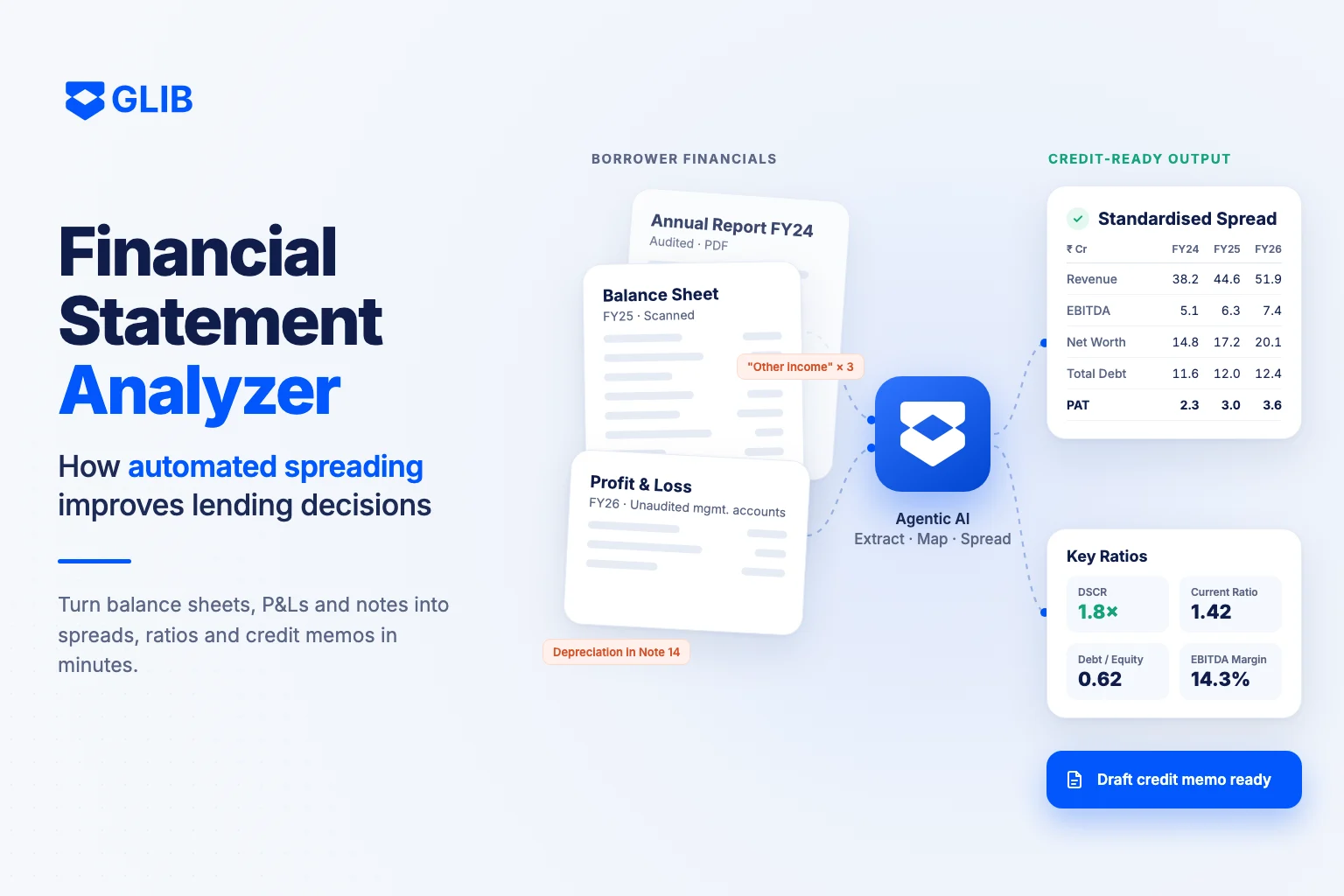
When a company applies for a working capital limit or term loan, the credit file usually includes three years of financial statements: a balance sheet, profit and loss account, cash flow statement, and the supporting notes and schedules.
These documents contain the information a credit analyst needs, but turning it into a usable format takes time. Financial spreading converts statements into a standard format so you can calculate ratios and compare the borrower against the lender’s benchmarks. At many institutions, this still happens in Excel, line by line.
Take an SME applying for a ₹5 crore credit limit. Two years of audited annual reports arrive as PDFs, and the most recent year is an unaudited management account. The line items are labelled differently from one year to the next, and depreciation sits in a note rather than on the P&L. Analysts spend hours copying figures and checking totals before they can calculate a single ratio.
Financial spreading automation removes much of this manual work by converting statements into a standard spread and calculating key ratios.
Why Manual Spreading Slows Down Lending
Every borrower reports differently
One company may report something as “other income,” while another splits the same information across three different categories. Analysts have to decide where each item belongs in the lender’s chart of accounts, and that process repeats for almost every file.
Important detail is buried in the notes
Contingent liabilities, related-party transactions, and details of secured loans often sit in the notes and schedules, not the main statements. When spreading is manual, analysts may skip some of these details because reviewing every note takes too much time.
Manual entry introduces errors
One wrong number can flow into the ratios, the scorecard, and the credit note without anyone noticing.
Two analysts, two answers
Two analysts may interpret the same file differently, which makes credit assessments harder to compare across the portfolio.
Meanwhile, the borrower is still waiting for a decision.
What a Financial Statement Analyzer Does
A financial statement analyzer takes financial statements in different formats and turns them into data that lenders can use for analysis. It can:
- Read balance sheets, P&L accounts, and cash flow statements from PDFs, scans, and digital exports
- Extract line items from the main statements as well as the notes and schedules behind them
- Map each item to the lender’s chart of accounts or taxonomy
- Spread multi-year financials for trend analysis
- Calculate liquidity, leverage, profitability, and coverage ratios such as DSCR
- Benchmark the borrower against peers
- Generate scorecards, risk assessments, and draft credit memos
Extraction is the easy half. The value sits in what happens after it.
How Agentic AI Changes Financial Spreading Automation
Intelligent document processing for banks handles the basic work: identifying documents, extracting information, and checking the data.
Agentic AI for lending takes this further by splitting the credit file into tasks handled by specialised agents:
| Agent | What it does |
|---|---|
| Spreading agent | Spreads the financials and calculates ratios |
| Credit memo agent | Prepares the draft credit note |
| Review agent | Checks the file for missing information or product requirements |
This means analysts spend less time putting the file together and more time reviewing it and making the credit decision.
Where Human Review Still Belongs
Unusual line items or new classifications can sometimes be mapped incorrectly. Human review gives analysts the final check: they can correct the mapping, approve the spread, and ensure every figure can be traced back to the original financial statement.
GLIB Financial Statement Analyzer
GLIB’s Financial Statement Analyzer uses agentic AI to turn financial statements into financial spreads, ratios, credit scorecards, risk assessments, and credit memos. It also looks beyond the main statements to find useful information in the notes and schedules of annual reports.
- Audited and unaudited: works with audited reports and unaudited management accounts from public companies and private SMEs
- Your taxonomy: maps different line items to the lender’s categories, with configurable ratios, formulas, and scoring rules
- Built for volume: processes hundreds of statements in batches, across more than 25 languages
- Human in the loop: analysts review, change, and approve results before they are used for credit decisions
- Connects to your stack: REST APIs and webhooks integrate with existing loan origination and credit decisioning systems
GLIB has processed over 10 million documents and saved more than 1.2 million man-hours for institutions including ICICI Bank, Bank of Baroda, TATA Capital, and Bandhan Bank.
What Automated Spreading Means for Credit Teams
As lending volumes grow, reviewing every file manually becomes harder. Financial spreading automation does not replace the analyst. It handles the repetitive data entry, so analysts can focus on reviewing the numbers and making credit decisions.
Decisions come out consistent across files and traceable to the source, and the borrower spends far less time waiting.
Want to see how automated financial spreading can fit into your credit workflow?