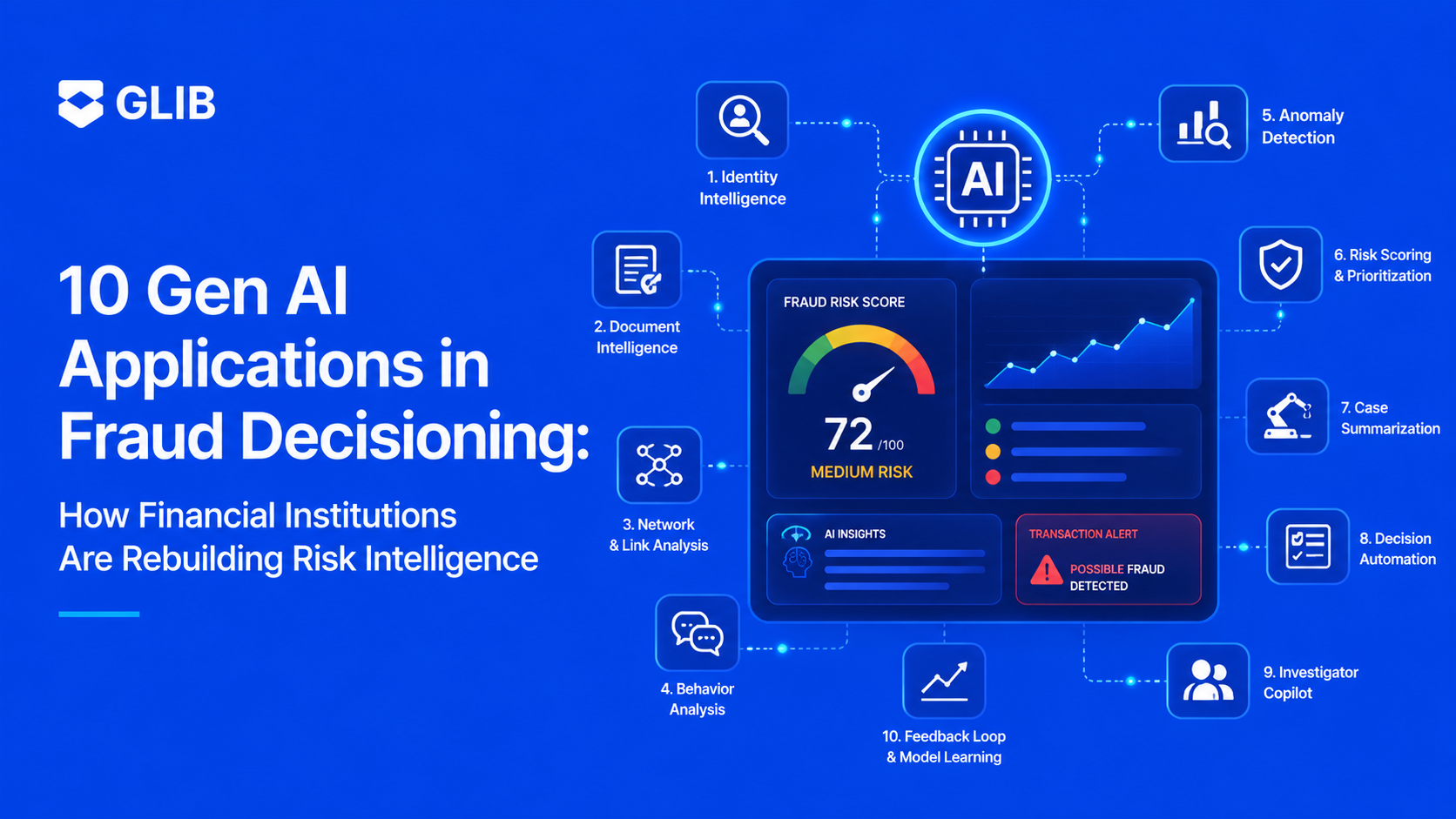
Fraud decisioning is undergoing a structural shift.
For the last two decades, most fraud systems in banking and lending were built around deterministic logic: predefined rules, static thresholds, watchlists, and retrospective pattern matching. These systems worked reasonably well in environments where fraud was repetitive and digitally unsophisticated.
That assumption no longer holds.
Modern fraud operations now face:
- Synthetic identity fraud networks
- AI-generated financial documents
- Multi-account transaction laundering
- Coordinated mule activity
- Sophisticated first-party fraud behavior
The problem is not simply that fraud volumes are increasing. Fraud has become increasingly unstructured, contextual, and adaptive.
Traditional fraud systems struggle because they are fundamentally designed to answer binary questions:
“Did this rule trigger?”
But modern fraud analysis requires systems capable of answering probabilistic and contextual questions:
- Does this financial behavior look authentic?
- Is this document internally consistent?
- Does the transaction pattern align with the declared income profile?
- Does this borrower narrative make sense across all submitted documents?
This is where Generative AI changes the architecture of fraud decisioning.
Unlike traditional machine learning systems optimized purely for classification, Gen AI models can reason across unstructured financial information, synthesize contextual signals, and generate explainable fraud insights that augment human investigators.
For financial institutions, this represents more than workflow automation. It represents a transition from static fraud detection toward adaptive fraud intelligence.
Why Traditional Fraud Decisioning Systems Are Breaking Down
Most legacy fraud systems were designed around structured data environments. Rules engines, scorecards, and supervised ML models depend heavily on predefined variables and historical labels.
However, fraud increasingly manifests in places where structured systems perform poorly:
- Financial documents
- Free-text explanations
- Behavioral inconsistencies
- Cross-document contradictions
- Transaction narratives
- Dynamic identity patterns
Consider bank statement fraud.
A traditional rules engine might flag:
- Unusually high deposits
- Salary mismatches
- Large cash transactions
But fraud investigators rarely make decisions based on isolated triggers. Instead, they analyze context:
- Are transaction flows behaviorally coherent?
- Does spending behavior align with declared income?
- Are there signs of layering or account cycling?
- Is this statement structurally authentic?
This contextual reasoning layer is precisely where Gen AI becomes valuable.
What Makes Gen AI Fundamentally Different in Fraud Analysis?
Most AI systems in fraud operate as prediction engines. They classify risk probabilities based on trained historical patterns.
Generative AI introduces a different capability stack:
- Contextual interpretation
- Semantic understanding
- Narrative synthesis
- Anomaly explanation
- Reasoning across unstructured inputs
This distinction matters significantly in fraud operations.
Fraud teams do not simply need risk scores. They need systems that can:
- Explain suspicious behavior
- Summarize inconsistencies
- Connect fragmented signals
- Accelerate investigative workflows
Gen AI effectively acts as an intelligence layer sitting above transactional and document infrastructure.
Instead of replacing existing fraud systems, it augments them by transforming raw financial information into investigation-ready intelligence.
1. Gen AI for Bank Statement Behavioral Analysis
Most fraud detection systems treat bank statements as static financial records.
Experienced investigators do not.
Human analysts read bank statements behaviorally. They assess:
- Income stability
- Transaction rhythm
- Account usage consistency
- Liquidity stress signals
- Hidden obligations
- Synthetic cash-flow patterns
Gen AI models can now replicate portions of this reasoning process.
Instead of extracting only transaction-level data, modern AI systems analyze behavioral coherence across entire statement histories.
For example, Gen AI can identify:
- Salary accounts with inconsistent spending behavior
- Accounts exhibiting cyclical transaction laundering
- Overdraft masking behavior
- Synthetic salary patterns
- Unusual velocity changes relative to historical behavior
This is especially valuable in unsecured lending and SME underwriting where traditional bureau data often provides incomplete risk visibility.
How GLIB Helps
GLIB’s AI-powered bank statement intelligence layer analyzes transaction behavior contextually rather than relying purely on keyword-based extraction.
This allows fraud and underwriting teams to identify suspicious financial behavior patterns earlier in the decisioning process.
2. Synthetic Identity Fraud Detection Using Cross-Document Reasoning
Synthetic identity fraud is fundamentally a contextual problem.
Fraudsters combine:
- Real identifiers
- Fabricated employment data
- Manipulated income records
- Synthetic digital footprints
The challenge is that each individual document may appear independently valid.
The fraud becomes visible only when analyzing relationships across datasets.
This is where Gen AI becomes structurally powerful.
Large language and reasoning models can compare:
- Employer consistency
- Address relationships
- Financial behavior alignment
- Income plausibility
- Identity chronology
Rather than relying solely on exact-match verification, Gen AI systems evaluate narrative consistency across the applicant profile.
This creates a significant improvement in detecting sophisticated onboarding fraud.
How GLIB Helps
GLIB enables cross-document financial analysis by correlating structured and unstructured data across statements, income proofs, and borrower submissions.
This helps investigators identify inconsistencies that static verification systems often miss.
3. AI-Generated Fraud Investigation Summaries
One of the most underestimated inefficiencies in fraud operations is investigative synthesis.
Fraud analysts spend substantial time:
- Reviewing documents
- Navigating fragmented systems
- Summarizing findings
- Writing case notes
- Escalating suspicious activity
The operational bottleneck is often not detection — it is interpretation.
Gen AI dramatically reduces this friction by generating investigation-ready narratives from underlying financial data.
Instead of presenting isolated alerts, the system can generate summaries such as:
“Applicant exhibits irregular salary deposits inconsistent with declared employer profile. Significant intra-account transfers suggest possible fund cycling behavior.”
This changes fraud operations materially because analysts spend less time aggregating signals and more time making decisions.
How GLIB Helps
GLIB converts raw financial analysis into structured fraud narratives and risk summaries that accelerate underwriting and investigation workflows.
4. Document Tampering and Financial Statement Manipulation Detection
Fraudulent document manipulation has evolved significantly with accessible editing tools and AI-generated content.
Today’s document fraud often includes:
- Metadata alteration
- PDF regeneration
- Transaction injection
- Screenshot fabrication
- Layout replication
Traditional OCR systems are poorly equipped to detect these manipulations because they focus primarily on text extraction.
Gen AI systems can analyze:
- Structural inconsistencies
- Formatting anomalies
- Semantic contradictions
- Document-generation irregularities
More importantly, they evaluate whether the document “behaves” like an authentic financial artifact.
This shift from text extraction toward document intelligence represents one of the most important advances in AI-driven fraud infrastructure.
How GLIB Helps
GLIB analyzes both financial data integrity and document structure to identify inconsistencies indicative of manipulation or fabrication.
5. Context-Aware Fraud Decisioning in Lending Workflows
Traditional fraud systems frequently generate false positives because they lack contextual understanding.
For example:
- High cash deposits may indicate fraud in one scenario
- But perfectly normal seasonal behavior in another
Gen AI enables context-aware interpretation by incorporating:
- Borrower profiles
- Industry behavior
- Historical transaction patterns
- Declared income narratives
This significantly improves decision quality because risk signals are interpreted within operational context rather than isolated rule frameworks.
For lenders, this means:
- Lower false-positive rates
- Faster approvals
- Improved fraud precision
How GLIB Helps
GLIB contextualizes financial data using AI-driven transaction analysis and borrower-level intelligence, enabling smarter fraud evaluations.
Must Do and Must Not Do When Implementing Gen AI in Fraud Decisioning
Must Do
Organizations implementing Gen AI in fraud systems should focus on augmentation rather than blind automation.
Successful implementations typically:
- Combine AI reasoning with investigator oversight
- Build explainable decision pipelines
- Maintain structured audit trails
- Continuously retrain fraud intelligence systems
- Integrate Gen AI into existing risk infrastructure
The highest-performing institutions treat Gen AI as a decision-support layer, not an autonomous fraud authority.
Must Not Do
Many organizations overestimate what Gen AI can safely automate in regulated financial environments.
Common implementation mistakes include:
- Deploying opaque black-box decision systems
- Eliminating human review entirely
- Relying on weak or fragmented financial data
- Ignoring compliance explainability requirements
- Automating inefficient workflows without redesign
Gen AI amplifies operational architecture — good or bad.
Poor fraud processes become more dangerous when scaled through automation.
Why Gen AI Will Reshape Fraud Infrastructure Over the Next Decade
The long-term impact of Gen AI in fraud decisioning is not merely operational efficiency. It is an architectural transformation.
Fraud systems are becoming:
- Adaptive
- Reasoning-driven
- Real-time
- Context-aware
Institutions that successfully operationalize Gen AI will build:
- Faster fraud response systems
- More scalable investigation operations
- Lower false-positive environments
- More intelligent underwriting workflows
Most importantly, they will gain the ability to detect fraud patterns that traditional systems were never designed to understand.
Conclusion
Fraud decisioning is becoming an intelligence problem rather than simply a detection problem.
As financial fraud becomes increasingly sophisticated, institutions need systems capable of contextual reasoning, behavioral interpretation, and unstructured financial analysis.
Generative AI provides this missing layer.
From bank statement intelligence to investigation copilots and cross-document reasoning, Gen AI is redefining how modern fraud infrastructure operates.
Platforms like GLIB enable financial institutions to operationalize these capabilities at scale by combining AI-driven financial document analysis with explainable fraud intelligence workflows.
Frequently Asked Questions
What is Gen AI in fraud decisioning?
Gen AI in fraud decisioning refers to the use of generative AI models to analyze financial data, identify suspicious behavior, and support fraud investigations using contextual reasoning.
How is Gen AI different from traditional fraud detection systems?
Traditional systems rely heavily on static rules and structured variables, while Gen AI can interpret unstructured financial information and generate contextual fraud insights.
Can Gen AI detect document fraud?
Yes. Gen AI can identify structural inconsistencies, manipulation patterns, and semantic anomalies in financial documents.
How does GLIB support fraud decisioning?
GLIB enables AI-powered financial document analysis, transaction intelligence, fraud detection, and investigation workflow automation for lenders and financial institutions.
👉 Want to see how GLIB enables AI-powered fraud decisioning and financial document intelligence?