For years, document processing has been viewed as a back-office necessity — a way to extract fields, classify pages, and reduce manual data entry. But as the financial ecosystem becomes increasingly digital, dynamic, and risk-sensitive, this reactive approach is no longer enough.
The next era of financial operations will be defined by predictive intelligence — systems that don’t just read documents, but anticipate risks, behaviors, fraud patterns, and opportunities hidden inside them.
This shift will fundamentally transform how banks, lenders, insurers, and financial ops teams operate.
From Capturing Data to Predicting Outcomes
Traditional OCR and early IDP tools were built for extraction. Modern GenAI-powered platforms are built for outcome prediction.
Instead of asking:
“What’s in this document?”
Financial institutions will ask:
“What will happen next based on this document?”
Predictive insights enable:
- Early detection of income instability
- Forecasting repayment behaviors
- Predicting cash-flow pressure
- Identifying customers at risk of churn
- Spotting fraud patterns before they escalate
- Pre-empting operational bottlenecks or anomalies
Documents become leading indicators, not historical records.
Why Predictive Insights Matter for Financial Institutions
Financial operations today are overloaded with transactional data but starved of forward-looking intelligence.
1. Customer Risk Trajectories Instead of Point-in-Time Checks
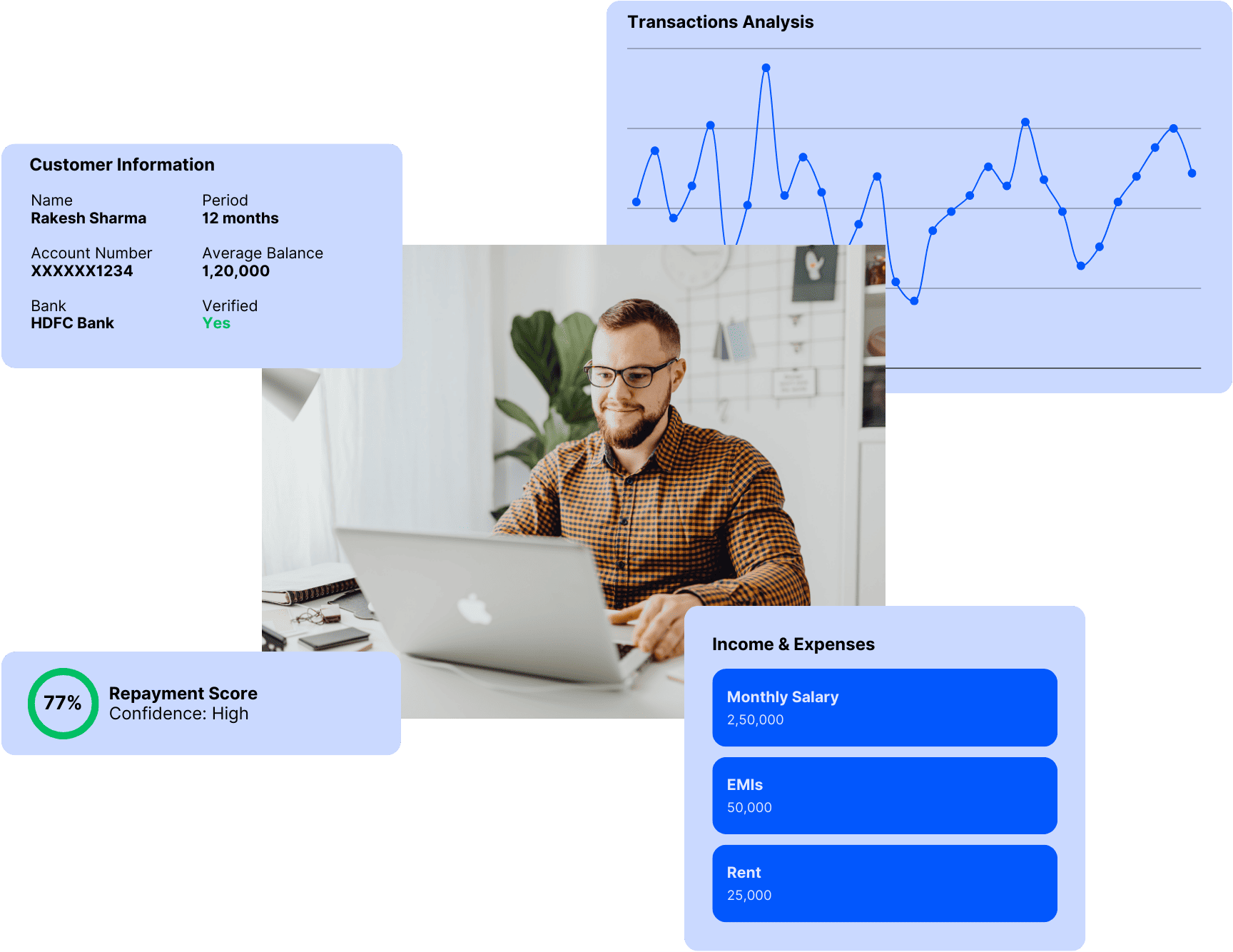
A single bank statement today is a snapshot. Predictive systems turn it into a trajectory - income patterns, EMI cycles, spending volatility, credit appetite, and repayment tendencies.
Instead of reactive underwriting, lenders get:
- Early warnings for delinquency
- Probability of default
- Predictive income consistency scores
This changes risk assessment from assessment to anticipation.
2. Fraud Scoring Built on Behavioral Fingerprints
Fraud rarely appears as a single event - it shows up as patterns.
Predictive IDP can detect:
- Unusual cash-flow spikes
- Suspicious cross-account movements
- Synthetic identity behaviors
- Pattern mismatches between financial documents
- AI-generated or manipulated statement traits
Instead of catching fraud late, institutions can prevent it early.
3. Predictive Ops Intelligence for Faster Decisions
Predictive systems can spot workflow issues before they occur:
- Which documents will likely fail processing?
- Which cases will need escalation?
- Which customer journeys are slowing down?
- Which compliance checks may trigger alerts?
This enables operations teams to preempt workload, balance queues, and accelerate throughput.
4. Personalized Product Recommendations
Banks and fintechs can use predictive signals from documents to recommend:
- Optimal credit limits
- Better loan structures
- Suitable investment products
- Personalized repayment plans
Document intelligence becomes a revenue engine, not a cost center.
How Predictive Insights Are Built Inside Modern AI-Native IDP
Predictive intelligence isn’t magic - it’s the outcome of a fundamentally new architecture in document processing.
It begins with deep document understanding, where GenAI models interpret context, tone, narratives, intent, behavioral clues, and semantic meaning to create a rich foundation for prediction. On top of this, modern platforms perform cross-document correlation across bank statements, income proofs, GST returns, invoices, contracts, and financial disclosures, unlocking multi-dimensional insights around financial stability, cash-flow predictability, business continuity, and risk exposure.
These systems then layer behavioral pattern modeling, mapping salary regularity, EMI cycles, expense flows, wallet movements, and merchant risk categories to forecast future behavior with remarkable confidence.
Finally, agentic orchestration converts these predictive insights into automated next steps - triggering additional checks, flagging anomalies, generating summaries, recommending decisions, and routing cases intelligently. In essence, agents transform prediction into autonomous action, completing the evolution from static document processing to intelligent decision automation.
What Predictive IDP Means for the Future of Financial Intelligence
Predictive IDP is not just a technology upgrade - it is a strategic reset for financial operations.
The future will look like this:
- Analysts won’t search for insights - insights will surface themselves.
- Underwriters won’t manually correlate documents - systems will provide a decision score.
- Fraud teams won’t chase anomalies - anomalies will alert themselves.
- Ops teams won’t estimate workloads - the system will predict and balance them.
Financial institutions will move from: Manual → Automated → Cognitive → Predictive → Autonomous
Where GLIB Leads the Shift
GLIB’s GenAI-powered Financial Intelligence Platform is built for this future. It doesn’t just extract or understand documents. It answers questions and predicts outcomes.
GLIB enables:
- Predictive risk scoring
- Anomaly forecasting
- Income stability prediction
- Cash-flow trend modeling
- Behavior deviation alerts
- Cross-document financial correlations
All inside a unified AI-native platform that can be queried in natural language.
With GLIB, documents don’t just tell you what happened - they tell you what’s likely to happen next.