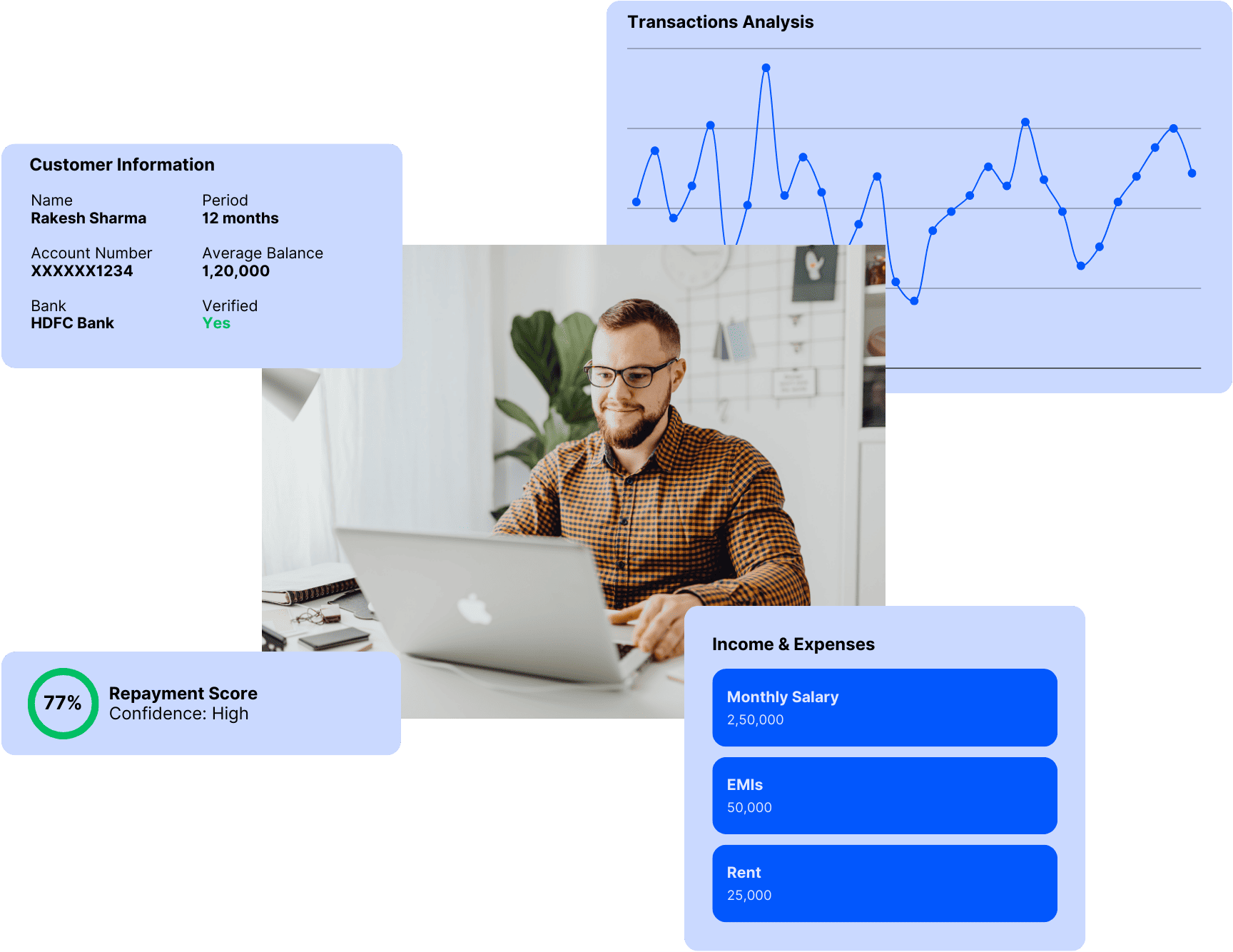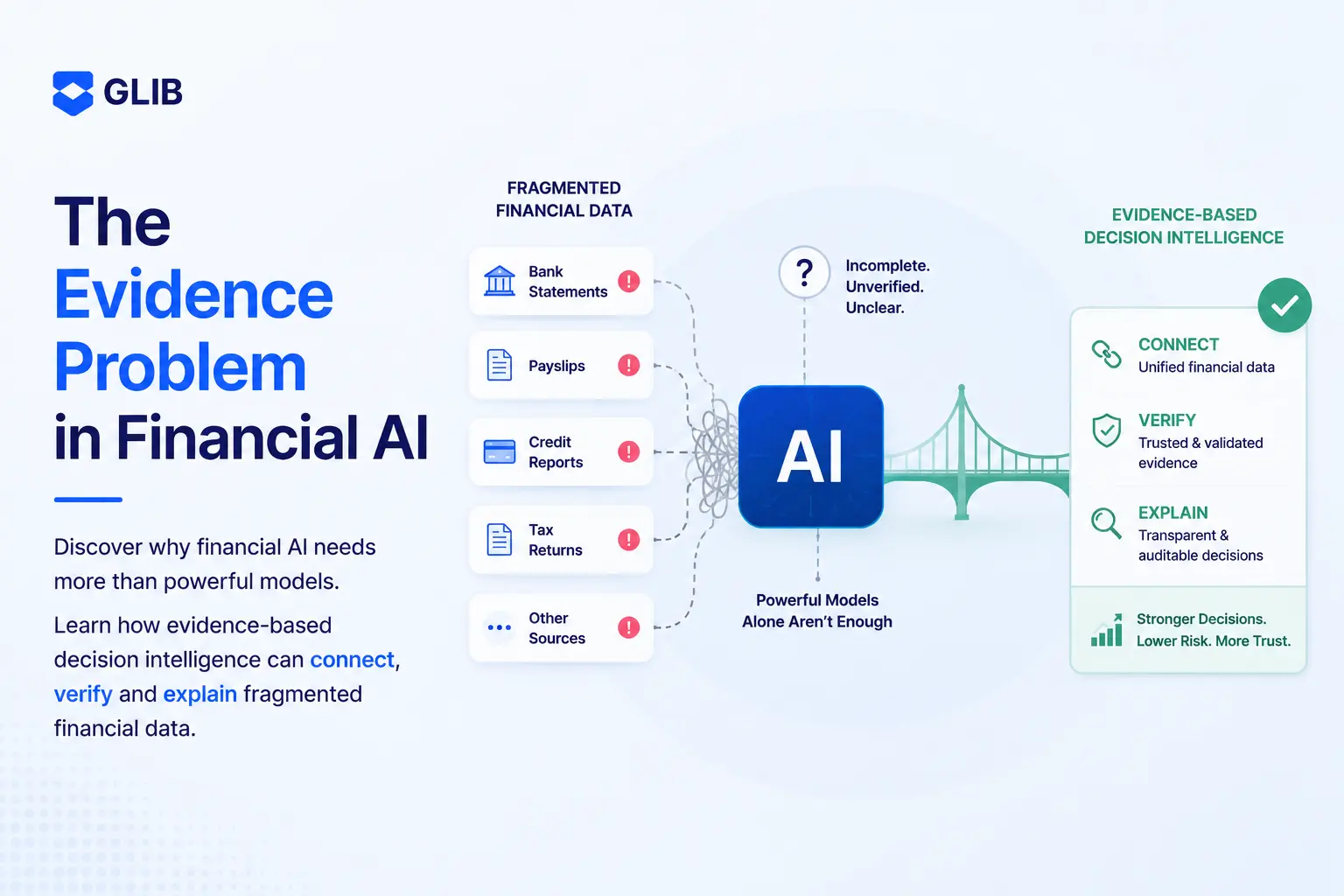
Artificial intelligence is rapidly changing financial services. Banks, NBFCs, insurers, and fintechs are using AI to automate underwriting, analyse financial documents, detect fraud, monitor risk, and accelerate customer onboarding.
But as AI moves from assisting decisions to influencing or making decisions, a more fundamental question is emerging:
Can AI show the evidence behind its decision?
This is becoming one of the most important challenges in financial AI.
The industry has invested heavily in better models, faster inference, and increasingly sophisticated AI agents. Yet the quality of a financial decision depends on more than the intelligence of the model.
It depends on whether the model has access to the right information, the right context, and reliable evidence.
And that evidence is rarely sitting in one place.
The Real Problem Is Not a Lack of Data
Financial institutions already have enormous amounts of data.
A single lending or onboarding decision may involve:
- Bank statements
- GST data
- Income tax returns
- Financial statements
- Payslips
- Invoices
- Bureau information
- KYC records
- LOS and LMS data
- CRM information
- Internal transaction data
The challenge is that these sources are often fragmented across systems, documents, and workflows.
A financial institution may have all the necessary information to make a decision—but still require significant manual effort to extract, reconcile, validate, and interpret that information.
This is why simply adding an AI model to an existing workflow does not automatically create intelligent decisioning.
GLIB’s own analysis of financial intelligence highlights this distinction: the next competitive layer is not simply more data or more dashboards, but the ability to understand financial behaviour, validate information, and turn fragmented data into decision-ready intelligence.
Better Models Cannot Compensate for Weak Evidence
Consider a credit assessment.
An AI model may identify a borrower as financially healthy based on reported income and transaction patterns.
But what happens if:
- The income reported in one source doesn’t match the bank statement?
- GST filings indicate declining business activity while financial statements show strong growth?
- Multiple documents contain conflicting addresses?
- Transaction patterns suggest that reported business revenue may include circular fund movements?
The model may be highly capable.
But if the underlying evidence is incomplete, inconsistent, or incorrectly interpreted, the resulting decision can still be wrong.
Better AI does not eliminate the need for better evidence.
In fact, the more autonomous AI becomes, the more important evidence becomes.
From Explainable AI to Evidence-Based AI
The conversation around AI in financial services has already moved toward explainability.
Financial institutions increasingly need to understand why an AI system reached a particular conclusion and which factors influenced the outcome.
But there is an important distinction between explaining a model output and proving a financial decision.
An explanation might tell you:
“Income stability was a key factor in this recommendation.”
An evidence-based decision should go further:
“Income stability was assessed using these transactions, these documents, and these verified data points—and these sources were reconciled before reaching the recommendation.”
The second approach creates a much stronger foundation for financial decisioning.
It connects the decision to the evidence behind it.
The Role of Agentic AI
This is where Agentic AI can change the architecture of financial decision workflows.
Traditional AI tools typically perform individual tasks:
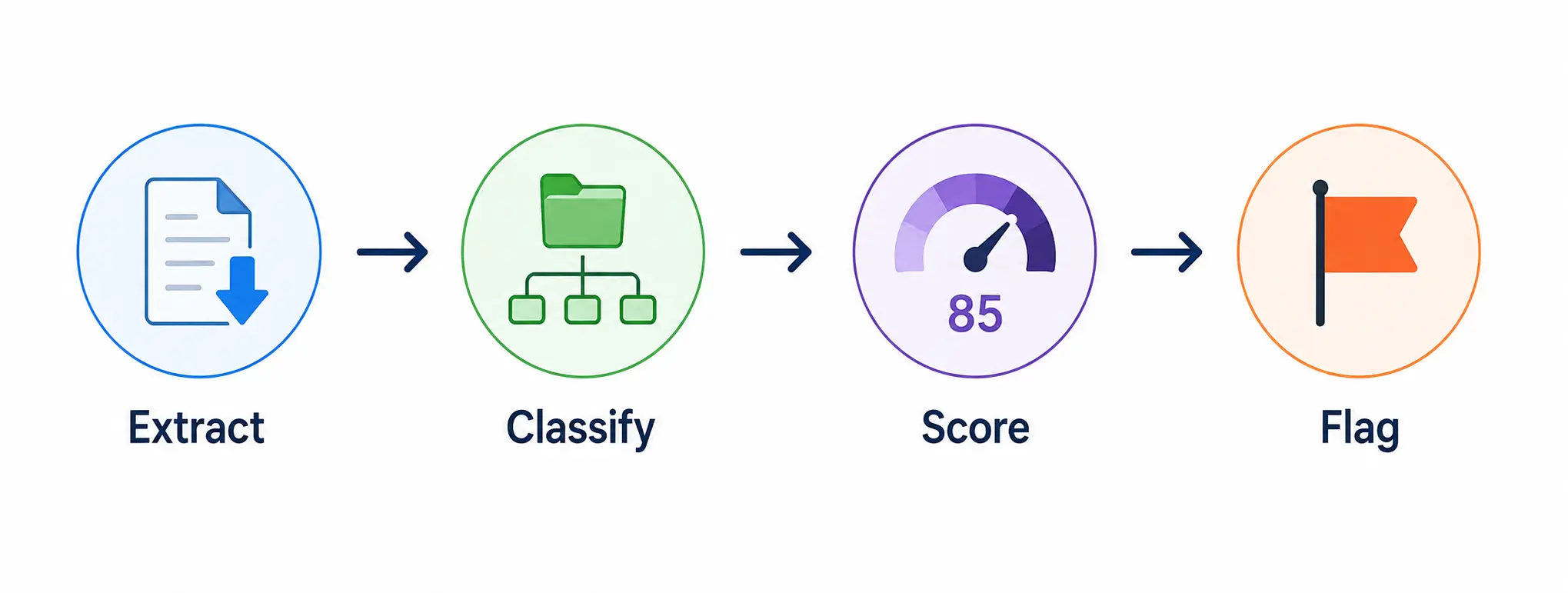
Agentic systems can orchestrate multiple specialised capabilities across a workflow.
For example, an AI-driven financial assessment could:
- Connect to relevant internal and external data sources.
- Analyse documents, transactions, and financial information.
- Identify relevant patterns, anomalies, and risk signals.
- Verify information across independent sources.
- Reason over the combined evidence.
- Recommend an appropriate decision or next action.
- Escalate exceptions to a human reviewer.
- Execute downstream workflow actions where authorised.
This represents a shift from AI performing tasks to AI orchestrating decision intelligence.
GLIB’s Agentic Decisioning & Automation approach is built around this broader model of specialised AI agents, decision orchestration, workflow automation, and human-in-the-loop governance.
Cross-Source Verification Is the Missing Layer
One of the most valuable capabilities in financial AI is therefore not simply extraction or prediction.
It is verification.
Imagine an MSME credit workflow where AI analyses:
GST → Bank Statements → Financial Statements → ITR → Bureau → Internal Data
The objective isn’t just to summarise each source.
The real intelligence comes from asking:
- Do these sources tell the same story?
- Where are the inconsistencies?
- Which information can be independently verified?
- What patterns indicate potential risk?
- What additional evidence is required?
- What should happen next?
This is where financial AI moves from information processing to evidence-based reasoning.
The Future of Financial Decisioning
Financial institutions are unlikely to stop using their existing LOS, LMS, core banking, KYC, bureau, or enterprise systems.
The opportunity is to make the ecosystem more intelligent.
An AI intelligence layer can connect information across these systems, analyse context, verify evidence, and orchestrate decisions without requiring every existing system to become an AI platform.
The architecture begins to look like:
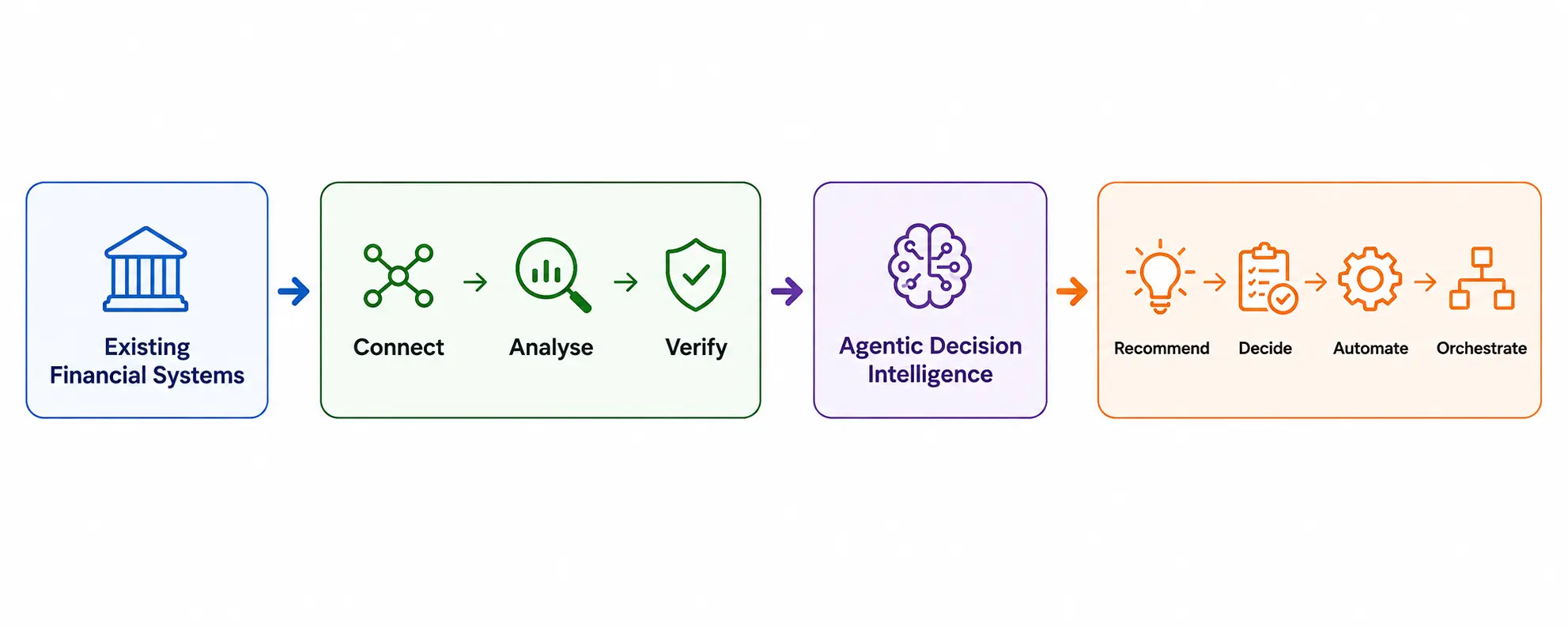
With humans involved wherever judgement, exception handling, or governance requires it.
The New Standard for Financial AI
The next phase of AI adoption in BFSI will not be defined only by:
How accurate is the model?
It will increasingly be defined by:
- What evidence did the AI use?
- Did it verify that evidence?
- Can the decision be explained?
- Can the institution audit what happened?
- Can a human intervene when necessary?
- Can the system move from insight to action?
That is the difference between AI that generates an answer and AI that supports a defensible financial decision.
The future of financial AI isn’t simply about building smarter models.
It is about building systems that can connect evidence, understand context, verify information, reason over it, and act with appropriate controls.
Because in financial services, intelligence without evidence creates uncertainty.
The next generation of AI must not just decide. It must be able to show why—and prove the evidence behind the decision.