Talk to any underwriter with thirty years in the seat, and they’ll describe the same scene without hesitation: a stack of bank statements, a highlighter, a calculator, and a deadline that arrived yesterday.
Manual bank statement review has always been the part of underwriting nobody talks about at conferences. It’s not glamorous. It doesn’t show up in the risk models. But it’s where a shocking number of bad decisions quietly get made — not because the lenders reviewing them are careless, but because the process itself is built to produce mistakes.
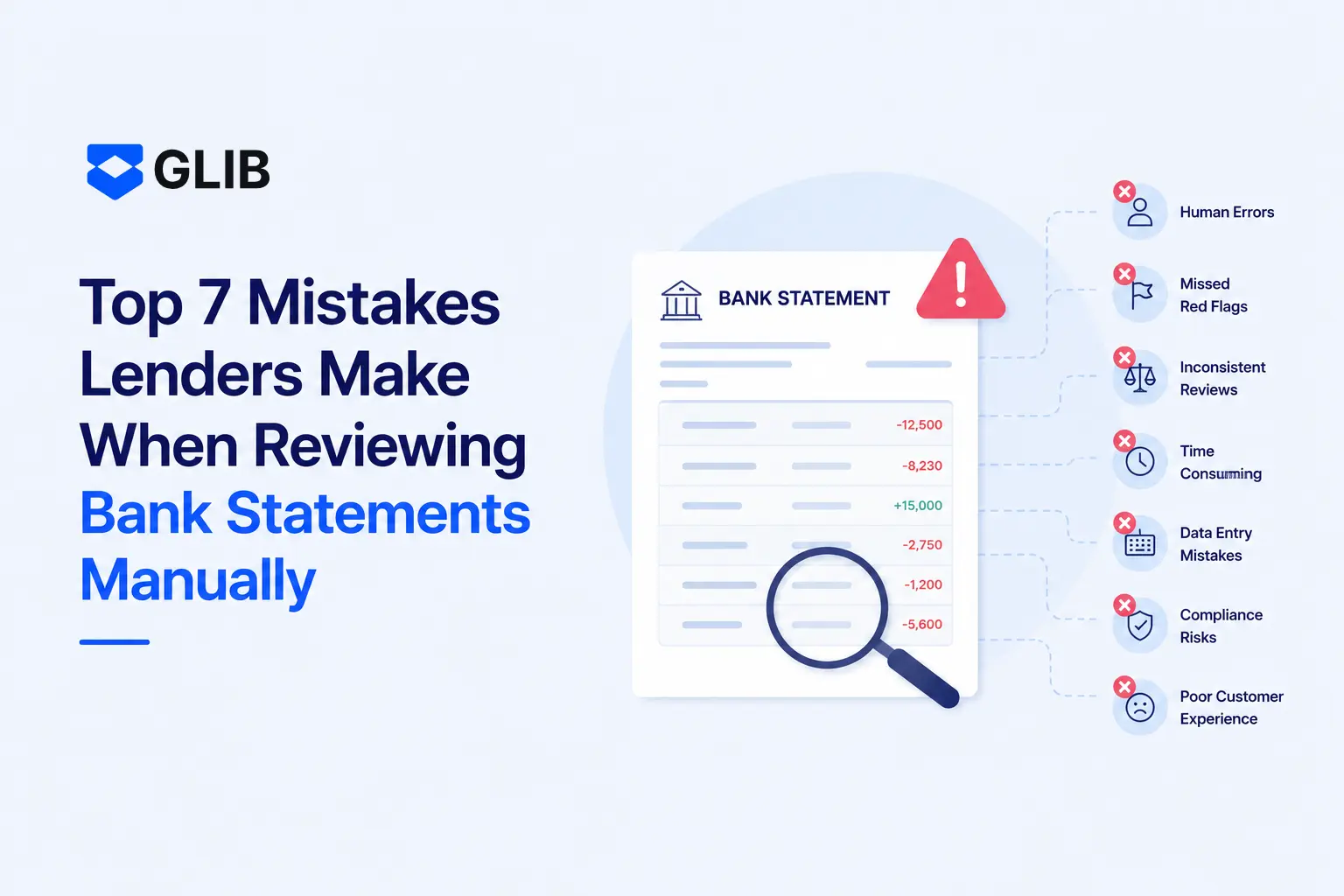
Even the sharpest, most experienced underwriters make these mistakes under deadline pressure, at 6pm on a Friday, with twelve more files still in the queue. Here are the seven that show up most often, and why they keep happening even at well-run institutions.
1. Skimming for round numbers and missing the pattern underneath
By the fifteenth statement of the day, an underwriter’s eyes naturally start hunting for big, obvious numbers — large deposits, large withdrawals, anything that jumps off the page. It’s a completely human way to read.
The problem is that fraud and financial distress rarely announce themselves in big numbers. They show up in patterns: a string of small, suspiciously round deposits right before month-end. Recurring transfers that don’t match any stated income source. A balance that always looks healthy on the statement date but dips dangerously low mid-cycle.
Manual review, done under time pressure, is optimized to catch outliers — not patterns. And patterns are usually where the real story is.
2. Treating average balance as the whole story
Average balance is the metric every underwriter reaches for first, and for good reason — it’s fast, it’s simple, and it’s a reasonable proxy for financial health. But plenty of lenders stop there.
One veteran underwriter recalls a file where the average balance looked comfortable, well above the threshold required. It wasn’t until someone dug into the daily balances that the team found the account had gone negative four times that quarter, each time bailed out by a same-day transfer from somewhere else. The average told a story of stability. The daily pattern told a story of an operator constantly one step from overdraft.
Average balance answers “how much, typically.” It doesn’t answer “how close to zero, how often.” Both questions matter, and manual review usually only has time for one.
3. Manually re-typing figures into a spreadsheet — and introducing errors nobody catches
This one isn’t a judgment call, it’s arithmetic, and arithmetic done by tired humans at volume is where a surprising number of underwriting errors originate. A transposed digit while re-keying a deposit total. A missed row when a statement runs onto a second page. A formula copied down one row too few.
Credit decisions have been built on spreadsheets where a single fat-fingered entry changed monthly revenue by an order of magnitude, and nobody caught it because the resulting number still looked “about right” at a glance. When the source data and the working file are two separate manual steps, there’s an opportunity for error built into every single statement, every single month, for every single file.
4. Missing transfers between the applicant’s own accounts
This is one of the more subtle mistakes, and one of the easiest to make when statements from multiple accounts are reviewed separately rather than side by side. Money moves from Account A to Account B, and if the accounts are reviewed independently, it can look like two separate inflows — effectively double-counting the same dollars as revenue or available funds.
This has inflated a borrower’s apparent cash position meaningfully, simply because nobody laid the accounts next to each other and traced where the money actually originated. It’s rarely intentional misrepresentation on the borrower’s part — it’s just a blind spot that’s very easy to have when working through PDFs one at a time.
5. Under-weighting seasonality because the file only shows three months
Most manual reviews work with whatever window of statements the borrower provided — commonly three months, sometimes six. That’s rarely enough to see a full seasonal cycle, and without actively asking “what time of year is this, and does it matter for this business,” it’s easy to badly misjudge what’s normal.
A landscaping business’s statements in April look nothing like its statements in December, and neither is more “true” than the other — they’re just different points in a cycle. Experienced underwriters have flagged completely healthy seasonal businesses as declining, and just as often, missed a business that’s actually contracting because the window happened to catch its strong season. Three months is a snapshot, not a story, and manual review rarely has the bandwidth to pull historical context beyond what’s sitting in the file.
6. Inconsistent judgment calls between underwriters — and even the same underwriter on different days
Every underwriter develops a mental shorthand for what counts as a “concerning” NSF pattern, what counts as legitimate business volatility, and what counts as a red flag. That shorthand is built from experience, and it’s genuinely valuable — but it’s also inconsistent, both across a team and within one person’s own judgment depending on the day, the caseload, and how the last three files went.
Credit committees have seen two files with nearly identical statement patterns receive different treatment because two different underwriters reviewed them, applying two different thresholds for what “acceptable” looked like. That’s not a knock on either underwriter — it’s just what happens when the review criteria live in someone’s head rather than in a documented, consistently applied standard.
7. Running out of time before running out of statements
This is the mistake underneath all the others, and arguably the most honest one to name. A thorough manual bank statement review — tracing transfers, checking daily balances against averages, cross-referencing multiple accounts, accounting for seasonality — takes real time. Underwriters rarely have as much of it as the process actually requires, especially during volume spikes.
So corners get cut, not out of negligence, but out of necessity. The statement gets the fifteen minutes there’s time for, not the forty-five minutes it deserves. Multiply that gap across a portfolio, and it becomes clear why so many “surprises” in a loan book weren’t surprises at all — they were sitting in the statements the whole time, just not fully reviewed.
Where this leaves lenders
None of these mistakes come from a lack of skill or diligence. They come from asking humans to do something at scale and speed that human attention was never really built for — cross-referencing hundreds of transactions across multiple accounts and months, consistently, every single time, without fatigue changing the outcome.
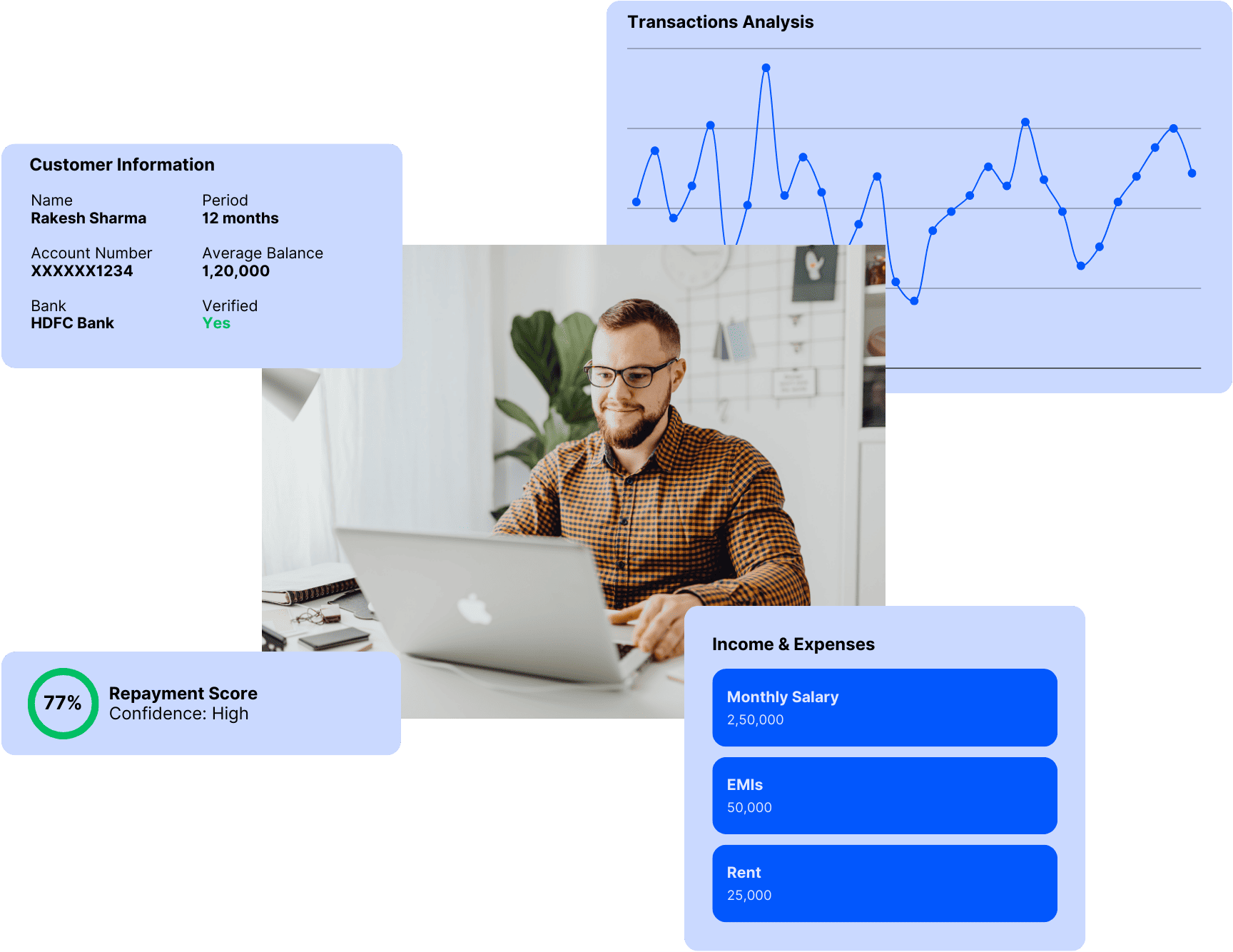
This is precisely the gap that a bank statement analyzer for underwriting is built to close: automatically reconciling daily balances against averages, tracing inter-account transfers, flagging patterns rather than just outliers, and applying the same standard of review to file one and file two hundred. It doesn’t replace an underwriter’s judgment — it protects the time and attention that judgment needs to actually be applied where it matters most.
After thirty years of watching good lenders get burned by small, avoidable oversights, the veterans of this industry tend to agree: that judgment is better spent deciding whether a borrower is a good risk — not re-checking arithmetic at 6pm on a Friday.
Curious how automated bank statement analysis catches what manual review typically misses? See how GLIB’s bank statement analyzer works for underwriting teams →