The Future of Financial Operations Is No Longer Just Automated — It’s Agentic
For years, financial institutions have invested heavily in workflow automation, rule engines, OCR tools, and AI models to improve operational efficiency.
Yet despite these investments, many critical processes across lending, onboarding, fraud detection, claims processing, and compliance still remain fragmented, manual, and heavily dependent on human coordination.
Why?
Because traditional automation systems were designed to automate tasks—not orchestrate intelligent decisions.
This is where a new category is emerging:
Agentic Decisioning & Automation Platforms
At GLIB, we believe this shift represents the next major evolution in financial operations.
The Problem with Traditional Financial Automation
Most financial institutions today operate with disconnected systems:
- One tool extracts data from documents
- Another verifies identity
- A separate system performs fraud checks
- Analysts manually review cases
- Decision engines apply static rules
- Operations teams coordinate approvals
Even after automation, workflows often look like this:
Documents → Multiple Tools → Human Coordination → Delays → Decisions
The Result
- Slow turnaround times
- Operational bottlenecks
- High manual effort
- Inconsistent decisions
- Increased fraud exposure
- Poor customer experience
Traditional workflow automation platforms improve efficiency, but they rarely create intelligent operational systems.
They automate steps.
They do not orchestrate autonomous decision operations.
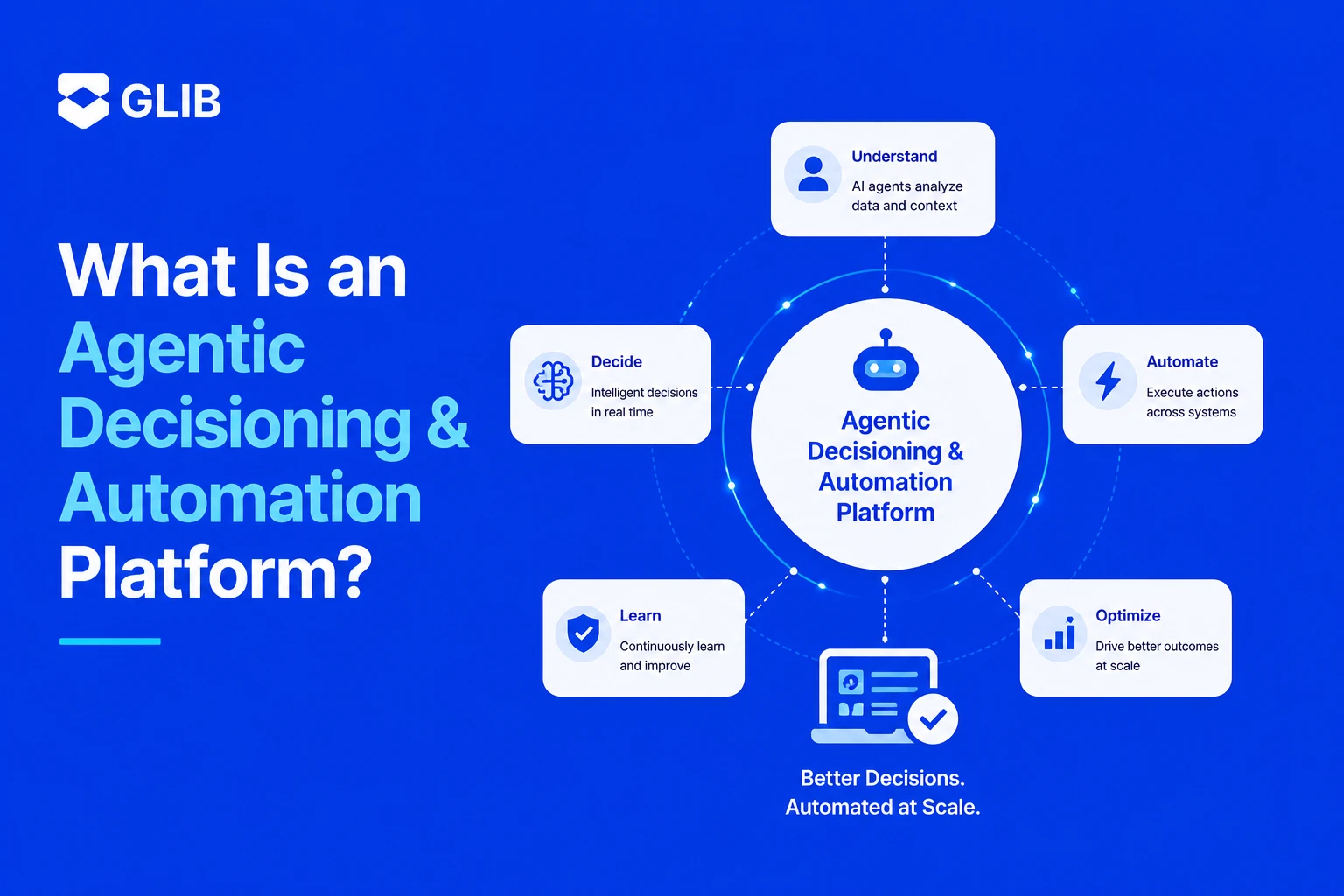
What Is an Agentic Decisioning & Automation Platform?
An Agentic Decisioning & Automation Platform combines:
- Specialized AI agents
- Decision orchestration
- Workflow automation
- Human-in-the-loop governance
- Real-time operational intelligence
Instead of simply automating tasks, the platform enables multiple intelligent agents to collaborate, analyze, validate, and execute operational decisions across financial workflows.
At its core, an agentic platform behaves less like software and more like an intelligent operational workforce.
Understanding AI Agents in Financial Operations
An AI agent is a specialized intelligent system designed to perform a focused operational task autonomously.
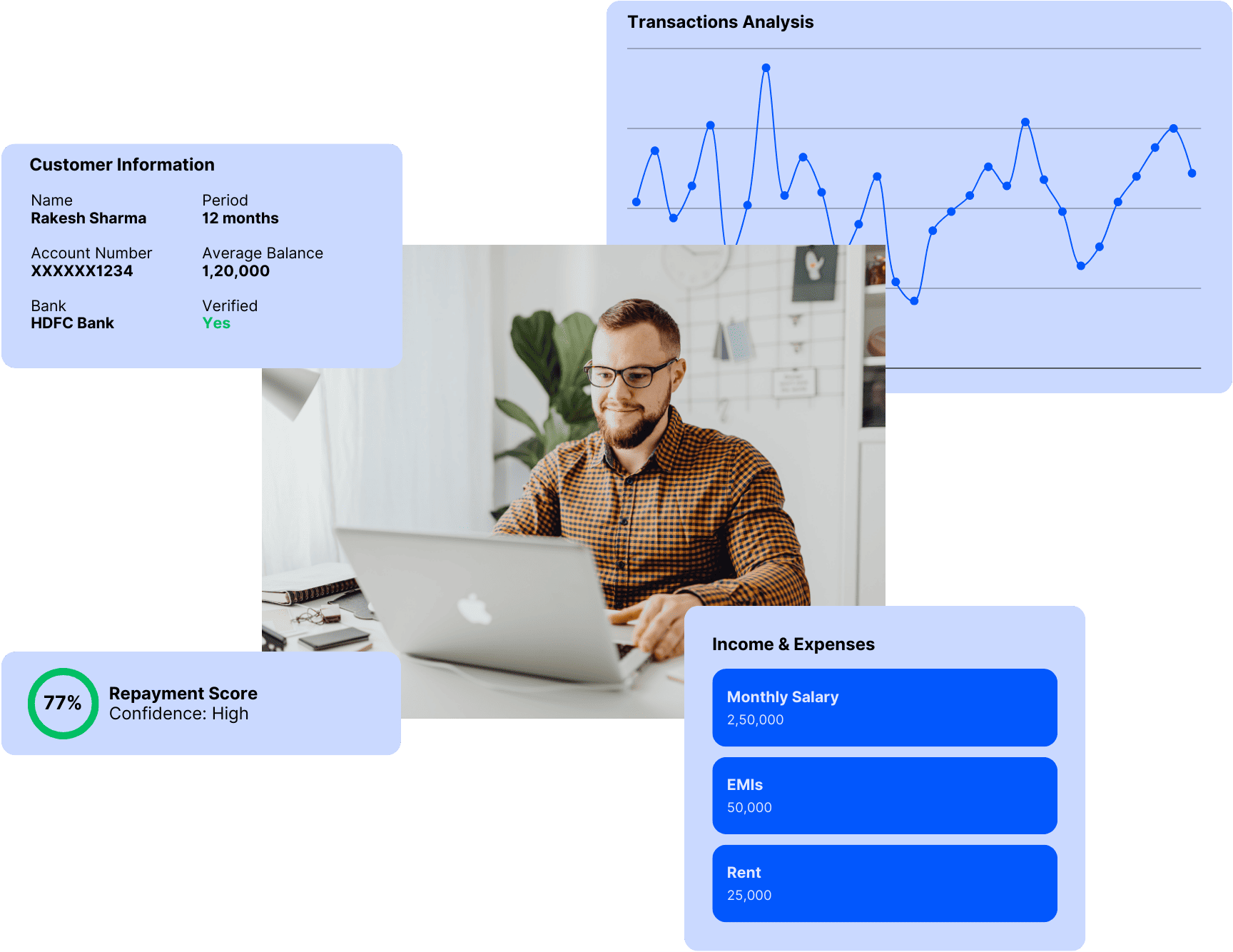
A Bank Statement Analysis Agent Can
- Extract transactions
- Detect salary patterns
- Analyze cash flow behavior
- Identify risk indicators
- Generate income insights
A Fraud Detection Agent Can
- Detect suspicious anomalies
- Cross-check risk indicators
- Validate identities
- Trigger escalation workflows
A KYC Agent Can
- Verify documents
- Validate identity information
- Match facial verification data
- Detect tampering or inconsistencies
Each agent performs a specific operational responsibility.
But the real power emerges when these agents work together inside orchestrated workflows.
From Workflow Automation to Decision Orchestration
Traditional automation platforms follow predefined workflows.
Agentic platforms orchestrate intelligent operational behavior.
That difference is critical.
Instead of static workflows:
IF document uploaded → extract text → send to reviewer
An agentic workflow behaves dynamically:
- AI agents analyze data
- Risk signals are evaluated
- Decisions adapt in real time
- Escalations occur automatically
- Human reviews happen only when needed
- Actions are continuously coordinated
This creates intelligent decision operations rather than simple process automation.
Real-World Financial Use Cases
- Lending and underwriting
- Fraud operations
- Customer onboarding and KYC
- Insurance claims processing
Why Agentic Platforms Matter Now
Financial institutions are facing increasing operational pressure:
- Rising customer expectations
- Higher fraud sophistication
- Regulatory complexity
- Margin pressure
- Operational scaling challenges
Traditional automation is no longer enough.
Organizations need systems that can:
- Analyze intelligently
- Coordinate dynamically
- Execute autonomously
- Adapt continuously
The Difference Between AI Tools and Agentic Platforms
Many companies today claim to offer AI automation.
But there is an important distinction.
AI Tool
Performs a single isolated function.
Example: OCR extraction.
Workflow Tool
Automates predefined steps.
Example: Rule-based approval routing.
Agentic Platform
Coordinates intelligent agents, decisions, workflows, and operational execution across end-to-end business processes.
This is the category GLIB is building for financial institutions.
The Future of Financial Operations
Over the next few years, financial institutions will increasingly move toward:
- Autonomous underwriting operations
- Intelligent fraud systems
- AI-assisted compliance workflows
- Agent-driven operational execution
- Real-time decision orchestration
The winners will not simply automate faster.
They will build intelligent operational infrastructure.
Final Thoughts
The future of financial operations is not about replacing humans with AI.
It is about enabling humans and intelligent agents to work together within orchestrated decision systems.
That is the promise of Agentic Decisioning & Automation Platforms.
At GLIB, we are building this future for financial institutions—enabling AI agents, workflows, and operational intelligence to work together at enterprise scale.
Because the next evolution of financial operations is not just digital.
It is autonomous, orchestrated, and agentic.
See Agentic Decisioning & Automation in Action
Ready to transform your financial operations with intelligent decision orchestration?
Learn how GLIB helps financial institutions automate decisions, orchestrate AI agents, and scale operations with confidence.