Every organisation wants faster customer onboarding.
Every board presentation includes metrics like Turnaround Time (TAT), application conversion, abandonment rate, and operational efficiency.
Yet, despite years of investment in digital journeys, OCR tools, eKYC platforms, and workflow automation, onboarding continues to be one of the most operationally intensive processes in financial services.
The question is simple:
Why?
The answer has very little to do with collecting documents.
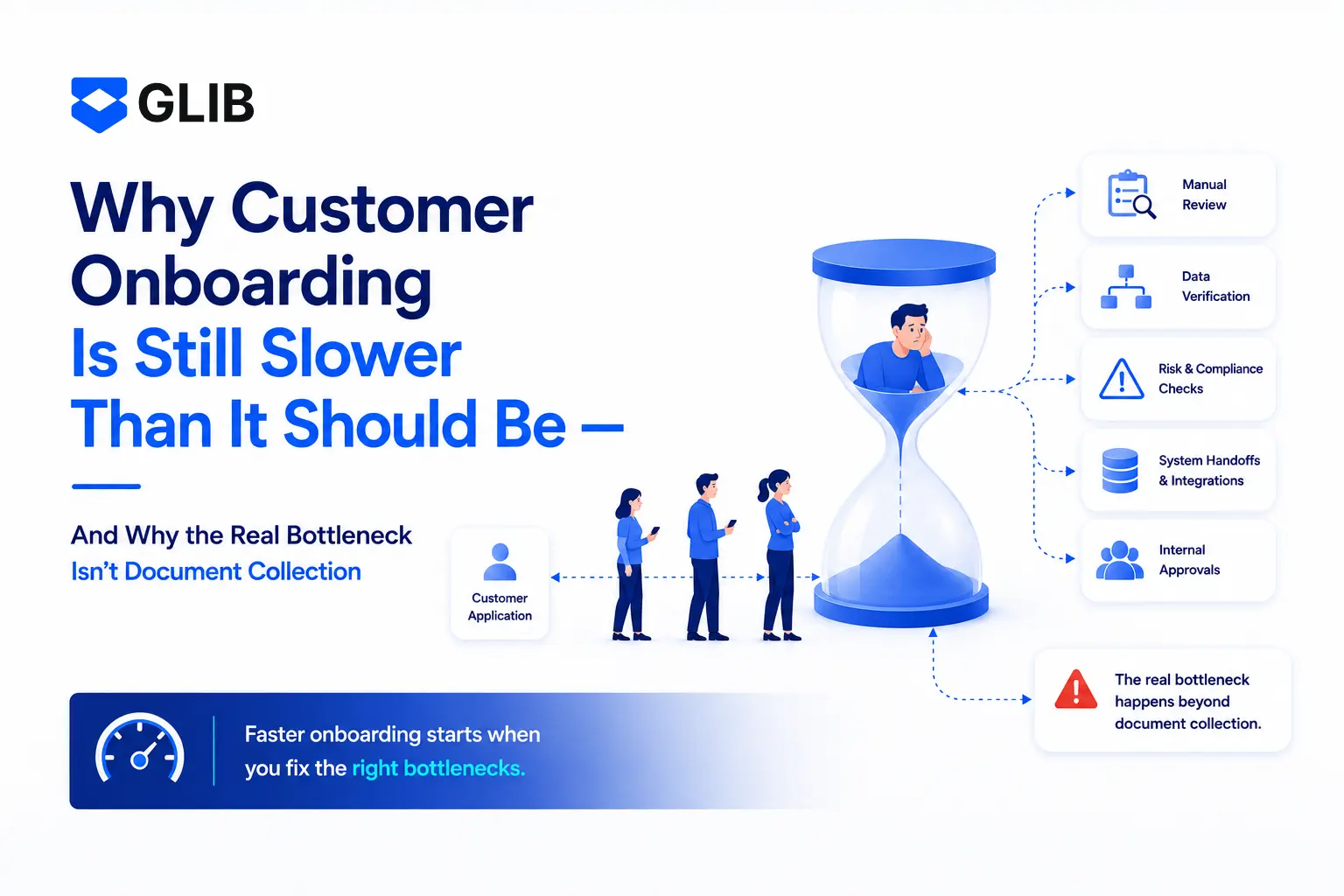
The real challenge begins after the customer clicks “Submit.”
The Myth: Documents Are the Bottleneck
Most digital onboarding journeys have solved the first mile remarkably well.
- Customers can upload documents from their phones.
- Identity can be verified digitally.
- Applications can be submitted within minutes.
From the customer’s perspective, the journey feels complete.
From the operations team’s perspective, the work has only just begun.
A typical onboarding case immediately enters a chain of operational activities:
- Classifying document types
- Checking document quality and completeness
- Extracting critical information
- Validating extracted data against application details
- Running eKYC checks
- Performing fraud detection
- Matching names across multiple documents
- Reviewing bureau reports
- Analysing bank statements
- Verifying GST records or financial statements for business applicants
- Escalating policy exceptions
- Routing applications for manual approval
None of these activities are inherently difficult.
What makes onboarding slow is that they rarely happen together.
Instead, they happen across different teams, different systems, and often at different times.
Every Handoff Creates Another Queue
Operations leaders understand one simple truth:
Queues don’t exist because people are inefficient. They exist because work is fragmented.
A document may move from an onboarding executive to a verification team.
The verification team may wait for another department to complete a bureau check.
Risk may wait for income validation.
Compliance may request another supporting document.
Customer service may follow up for clarification.
Each team performs its role correctly.
Yet the customer experiences only one thing:
Waiting.
The operational challenge isn’t document processing.
It’s workflow coordination.
Onboarding Is a Decision Journey, Not a Document Journey
If we map every activity in onboarding, something interesting becomes clear.
Almost every task supports one objective:
Making a confident business decision.
Every onboarding process ultimately needs to answer questions like:
- Can we trust this identity?
- Is the declared income sufficient?
- Does the bank statement support the declared salary?
- Are there signs of financial stress?
- Is the GST data consistent with reported business turnover?
- Does this application comply with lending policy?
Documents don’t answer these questions by themselves.
People do.
Which is why many organisations still depend heavily on manual reviews.
The issue isn’t a lack of data.
It’s the effort required to connect it.
Documents Rarely Tell the Full Story
A bank statement doesn’t exist in isolation.
It must be interpreted alongside:
- Bureau history
- Salary slips
- GST returns
- Financial statements
- Application details
- Internal policy rules
- Existing customer relationships
Each source contributes one piece of the decision.
Unfortunately, many organisations still review these sources independently.
The result is:
- Repetitive work
- Inconsistent decisions
- Avoidable delays
Why Traditional Automation Falls Short
Over the past decade, organisations have successfully automated individual tasks.
- OCR extracts text.
- RPA moves files.
- Rule engines validate predefined conditions.
- Workflow systems assign tasks.
These technologies have delivered measurable efficiency gains.
However, they still require humans to connect the dots.
Someone still needs to determine whether all available information supports the next action.
That coordination layer remains largely manual.
The Missing Layer: Decision Orchestration
This is where the conversation needs to shift.
The future of onboarding isn’t about processing documents faster.
It’s about orchestrating decisions better.
Imagine an onboarding workflow where:
- Documents are automatically classified the moment they arrive.
- Identity details are validated across multiple sources.
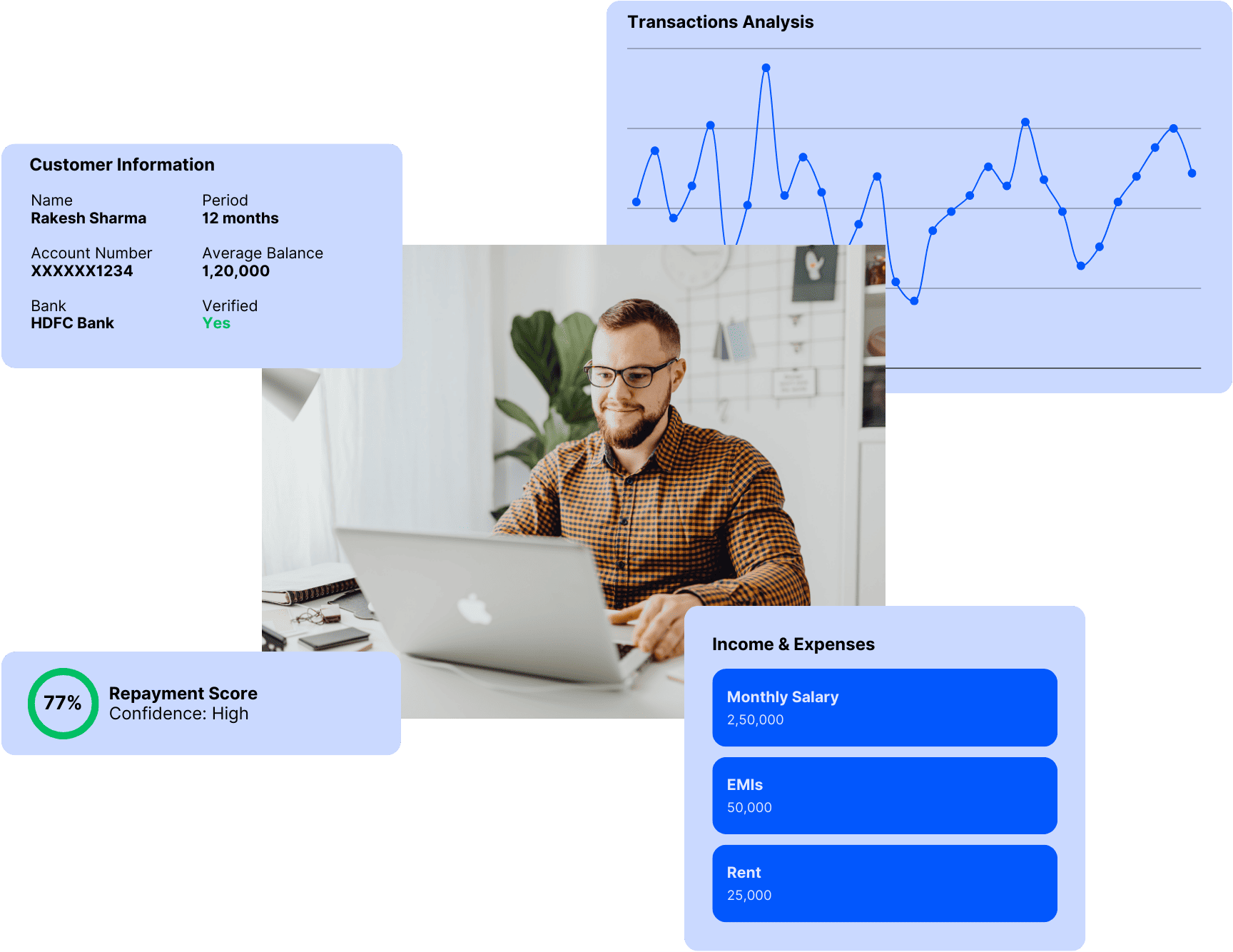
- Bank statements are analysed for income patterns, liabilities, and financial behaviour.
- GST data is reconciled with declared business information.
- Bureau insights are incorporated automatically.
- Fraud indicators are continuously evaluated.
- Policy exceptions are detected in real time.
- Low-risk applications move forward automatically.
- Complex cases are routed to the right reviewer with complete context.
The objective isn’t to eliminate human judgement.
It’s to ensure that human expertise is applied only where it creates the most value.
Where Document AI Fits
Document AI transforms documents from static files into structured, decision-ready information.
Instead of asking operations teams to manually review every document, Document AI can:
- Automatically classify document types
- Extract relevant information
- Validate data across multiple documents
- Detect inconsistencies
- Flag missing information
- Identify potential fraud indicators
- Prepare applications for downstream decisioning
This significantly reduces operational effort while improving consistency.
But extraction alone doesn’t complete onboarding.
Where Agentic Decisioning Changes the Game
Once reliable information is available, the next challenge is determining what should happen next.
This is where Agentic Decisioning introduces a new layer of intelligence.
Instead of waiting for manual coordination, intelligent agents can orchestrate the entire decision workflow by:
- Determining which verification should happen first
- Automatically triggering bureau and financial analysis
- Applying lending and compliance policies dynamically
- Prioritising applications based on business rules and risk
- Routing only genuine exceptions for human review
- Creating complete audit trails for every decision
The outcome isn’t simply faster processing.
It’s a more consistent, explainable, and scalable onboarding operation.
Traditional Automation vs Agentic Decisioning
| Traditional Onboarding | Agentic Decisioning |
|---|---|
| Documents processed independently | Information connected across sources |
| Sequential verification | Parallel, orchestrated verification |
| Manual coordination between teams | Intelligent workflow orchestration |
| Static rule execution | Context-aware decisioning |
| Humans connect the dots | AI prepares complete decision context |
| Higher operational delays | Faster time to decision |
The KPI That Matters Most
Operations teams have traditionally measured success using Turnaround Time (TAT).
That metric will always remain important.
But the organisations leading the next phase of digital transformation will increasingly optimise for something else:
Time to Decision
Customers don’t remember how quickly they uploaded their documents.
They remember how quickly your organisation responded.
Final Thought
Customer onboarding has never been a document problem.
It has always been a decision problem disguised as a document process.
As financial institutions continue to scale digital channels, competitive advantage won’t come from collecting more information.
It will come from:
- Connecting information intelligently
- Orchestrating workflows seamlessly
- Enabling faster, more confident decisions
This is where Document AI and Agentic Decisioning together redefine onboarding—not by replacing people, but by enabling operations teams to spend less time chasing documents and more time making decisions that move the business forward.
About GLIB
GLIB’s Agentic Decisioning & Automation Platform helps financial institutions accelerate customer onboarding by combining AI-powered Document Intelligence, financial data analysis, workflow orchestration, and explainable decisioning.
By transforming fragmented information into intelligent, automated workflows, GLIB enables lenders to reduce operational effort, improve consistency, and deliver faster decisions with confidence.