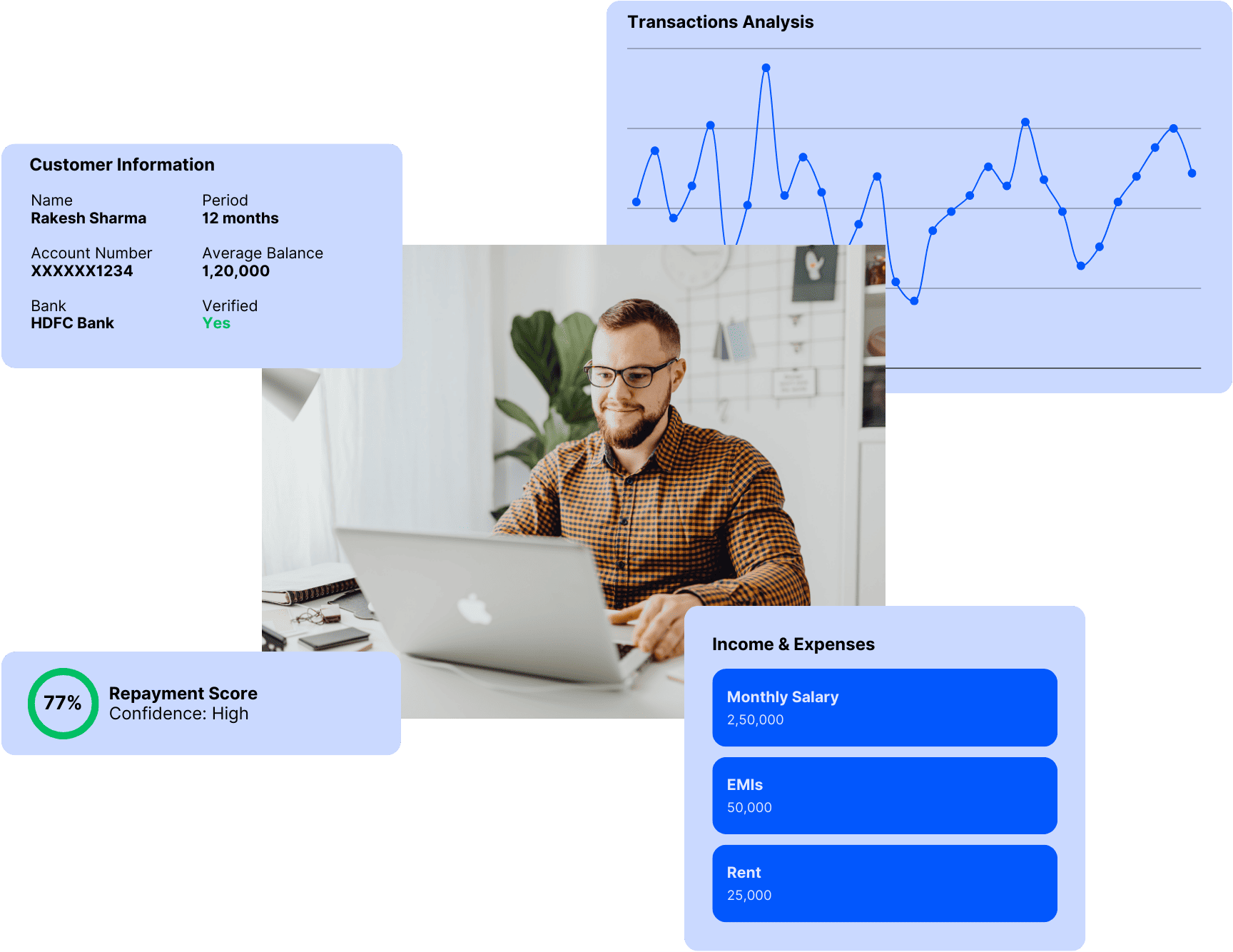
Imagine this. You upload a bank statement into a document AI system. Within minutes, it maps 1,700+ transactions across 12 months. Income patterns. Spending behaviour. Risk indicators. What would traditionally take hours of manual effort is now done in minutes.
So why does credit decisioning still take days?
The Illusion of Progress in Lending
Over the last decade, lending institutions have invested heavily in:
- Credit scoring models
- Rule engines
- Data integrations
- Digital onboarding journeys
On paper, the system looks efficient. Data flows in. Models generate outputs. Decisions are expected to follow. But in practice, something still slows everything down.
That “something” is rarely discussed.
The Real Bottleneck: Interpretation
The challenge in lending today is not access to data. It is the ability to interpret financial evidence at scale. Consider what underwriters actually deal with:
- Bank statements with thousands of transactions
- GST returns with varying formats
- Income tax filings with declared figures
- Financial statements with contextual nuances
These are not structured datasets. They are context-heavy documents that require understanding, not just extraction. And this is where most systems fall short.
Extraction Is Not Understanding
Most document processing systems today are built to:
- Extract fields
- Digitize content
- Standardize formats
But lending decisions don’t rely on fields. They rely on meaning.
For example:
- Is the income stable or seasonal?
- Are inflows consistent with declared revenue?
- Do spending patterns indicate financial stress?
- Are there hidden liabilities reflected in transactions?
These are not questions a traditional system can answer. Because they require interpretation across data, not just extraction from it.
Why Decisions Still Take Time
Even in highly digitized lending environments, human intervention persists. Not because teams resist automation. But because they don’t trust incomplete understanding.
So what happens?
- Documents are manually reviewed
- Cross-verifications are done offline
- Exceptions are escalated
- Decisions are delayed
The system may be fast. But the decision layer remains slow.
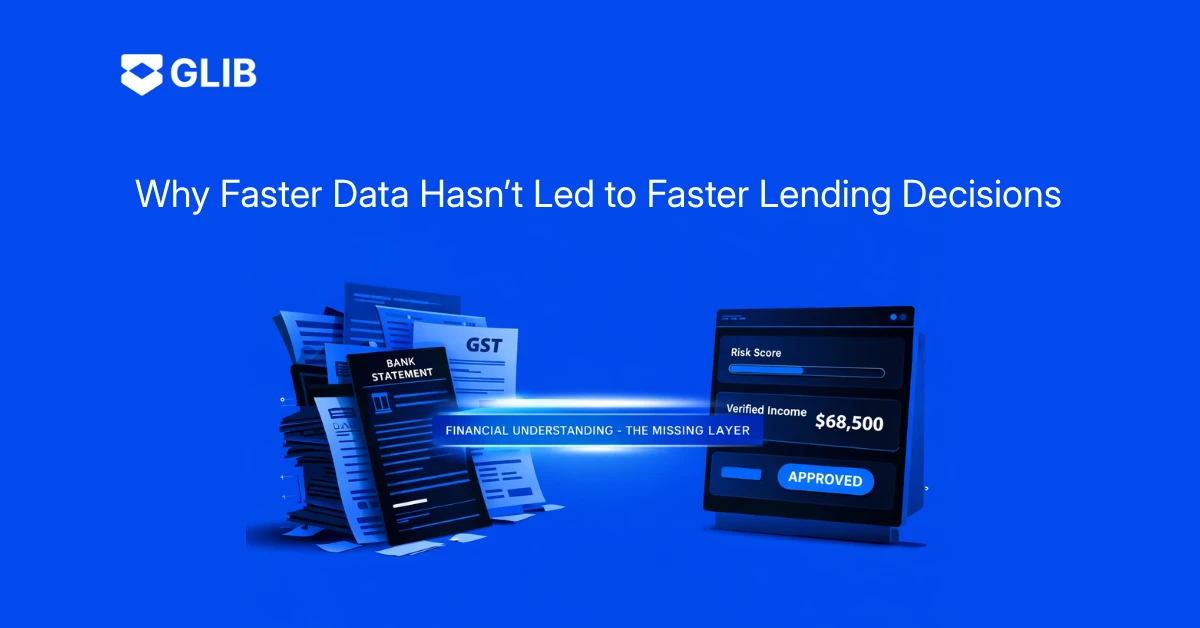
The Missing Layer: Financial Understanding
What’s emerging now is a new layer in the lending stack:
Financial Understanding
This sits between data extraction and decisioning.
It enables systems to:
- Interpret transaction behavior
- Compare across multiple documents
- Identify inconsistencies
- Surface risk indicators automatically
In essence, it transforms raw data into decision-ready intelligence.
From Models to Meaning
For years, the focus has been on improving models. Better algorithms. Better scoring techniques. But models are only as good as the inputs they receive. If the underlying financial interpretation is weak, even the most advanced model will produce unreliable outcomes. The real shift happening now is this:
From model-centric lending to understanding-centric lending.
What This Means for BFSI Leaders
For leaders in lending, the implications are significant:
- Speed will depend on interpretation, not data availability
- Risk will increasingly be hidden in unstructured financial evidence
- Competitive advantage will come from decision intelligence, not just scoring models
The institutions that solve this layer will:
- Reduce turnaround times
- Improve risk accuracy
- Scale decisioning without scaling teams
Closing Thought
The industry often asks: “How do we make lending faster?”
But perhaps the better question is: “How do we make financial data truly understandable?”
Because until that is solved, faster decisions will remain an illusion.