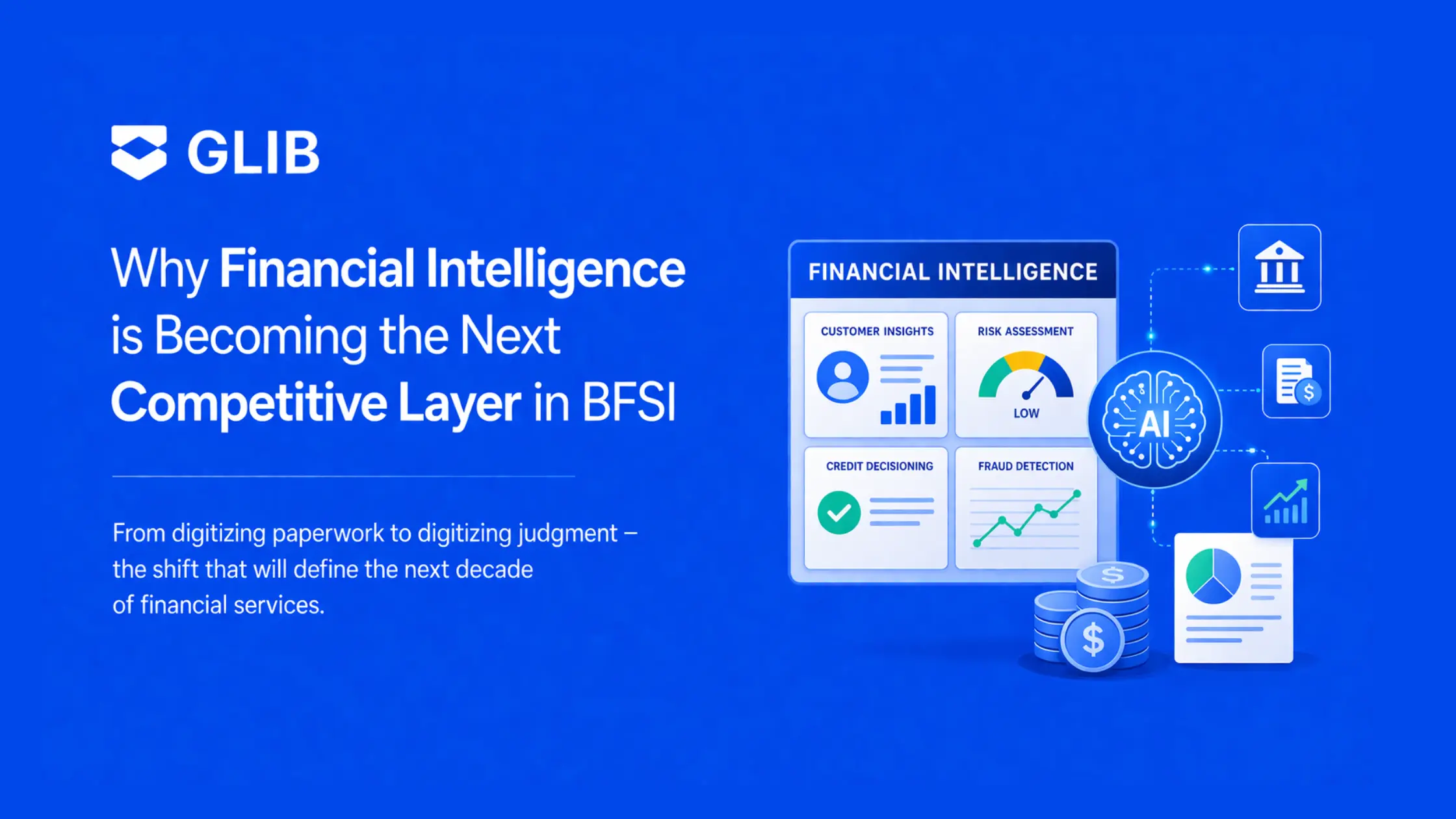
For over a decade, digital transformation in BFSI has largely followed a predictable path:
- Digitize documents.
- Automate workflows.
- Deploy AI models.
And to be fair, this has delivered real gains—faster onboarding, reduced operational costs, and improved scalability. But beneath this progress, a more fundamental shift is now underway.
BFSI is moving from digitizing paperwork to digitizing judgment. This shift is subtle—but it is redefining where competitive advantage will lie in the next decade.
From Data Processing to Decision Making
Across core use cases—bank statement analysis, financial statement interpretation, invoice processing, digital lending, and KYC—the role of technology is evolving.
Earlier, systems were designed to:
- Extract data
- Organize it
- Present it for human review
Today, systems are expected to:
- Interpret financial behavior
- Validate authenticity
- Enable decisions with minimal human intervention
This is no longer just automation. It is an attempt to replicate judgment.
And judgment requires something most systems still lack: Trusted financial intelligence.
Three Forces Driving This Shift
1. Regulation is Raising the Bar on Accountability
Regulators are increasingly clear: automation does not dilute responsibility—it amplifies it.
In India, the Reserve Bank of India (RBI) Digital Lending Directions (2025) were introduced to address growing concerns around:
- Third-party (LSP) involvement
- Mis-selling practices
- Data privacy breaches
- Unfair recovery methods
The guidelines explicitly require regulated entities to:
- Ensure proper creditworthiness assessment of borrowers
- Maintain transparency in disclosures
- Govern data collection and usage rigorously
- Retain accountability even when outsourcing to fintech partners
This creates a critical shift. Lenders can no longer rely on opaque systems or third-party processes. They must be able to explain:
- How a decision was made
- What data was used
- Whether that data was reliable
In other words, “automation with accountability” is becoming non-negotiable.
2. Data Abundance is Exposing Decision Gaps
The volume of financial data available today is unprecedented.
According to industry estimates, over 80% of underwriting data in digital lending now comes from non-traditional or semi-structured sources—including bank statements, GST data, invoices, and transaction histories. Yet, paradoxically, decision accuracy has not improved at the same rate.
Because most systems still operate on a linear model:
Extract → Classify → Score
But real-world decisioning requires:
Interpret → Validate → Trust
Consider bank statements. A transaction feed can show inflows, balances, and spending patterns. But it does not inherently reveal:
- Whether income is stable or artificially structured
- Whether funds are genuine or circular
- Whether behavior reflects long-term sustainability
Without context, data creates signals. But not certainty.
3. Speed Without Certainty is Becoming a Liability
In the early phase of digital lending, speed was the differentiator. Faster approvals meant better customer acquisition. Instant decisions became the benchmark.
However, this has introduced new risks.
A report by the Bank for International Settlements (BIS) highlighted that rapid digital credit expansion—especially when driven by alternative data—can increase credit risk volatility if underlying data quality is weak.
Similarly, in India, regulators have flagged rising concerns around:
- Over-leveraging of borrowers
- Inadequate credit assessments
- Algorithmic opacity
This is why speed, in isolation, is no longer sufficient.
Faster decisions based on unverified or misinterpreted data can lead to:
- Mispriced risk
- Increased defaults
- Regulatory intervention
- Loss of customer trust
As a result, leading institutions are shifting focus: From speed → to certainty at scale.
Where Current Systems Fall Short
Despite advancements in AI, three structural challenges persist:
- Fragmented Data Ecosystems: Financial data exists across multiple sources—banks, financial statements, GST filings, invoices—without a unified interpretation layer.
- Lack of Contextual Understanding: Most systems identify what happened but not why it happened. A credit entry is treated as income. A balance is treated as liquidity. But without context, these assumptions can be misleading.
- Limited Data Trust Frameworks: There is little standardization in how data reliability is assessed. Systems score borrowers—but rarely score confidence in the data itself.
Industry Example: When Data Misleads
Consider a common SME lending scenario. A borrower presents bank statements showing:
- Regular inflows
- Healthy balances
- Positive transaction activity
An automated system classifies this as stable income and low risk.
However, deeper analysis reveals:
- Inflows originate from a linked account
- Funds circulate between accounts
- Transactions are reversed periodically
What appears as business revenue is actually circular fund movement. Without contextual validation, the system makes a flawed decision. This is not an edge case—it is increasingly common in digital ecosystems.
Financial Intelligence: The Next Competitive Layer
This is where financial intelligence emerges as a differentiator. Not in the sense of more dashboards or more data pipelines.
But as a capability that enables systems to:
- Understand financial behavior—not just transactions
- Validate data authenticity before decisioning
- Detect anomalies without manual intervention
- Assign confidence scores to data inputs
In essence, financial intelligence bridges the gap between: Data → Decision
What This Means for BFSI Leaders
For CDOs, credit heads, and risk leaders, the strategic question is shifting.
It is no longer: “How do we process more data faster?” It is: “How do we ensure the data driving our decisions can be trusted without human validation?”
Because once that problem is solved:
- Decision cycles shrink dramatically
- Operational costs reduce sustainably
- Risk becomes more predictable
- Compliance becomes easier to demonstrate
The Road Ahead
The next phase of BFSI transformation will not be defined by:
- More AI models
- More alternative data sources
- Faster processing speeds
It will be defined by who solves the problem of data trust at scale.
Because in a world of automated decisioning, the real competitive advantage is not access to data—It is the ability to trust it.
Closing Thought
We are entering an era where every credit decision must be:
- Instant
- Explainable
- Accountable
And that is only possible when financial data evolves from raw inputs into decision-ready intelligence. The institutions that recognize this shift early will not just move faster—They will move with certainty.