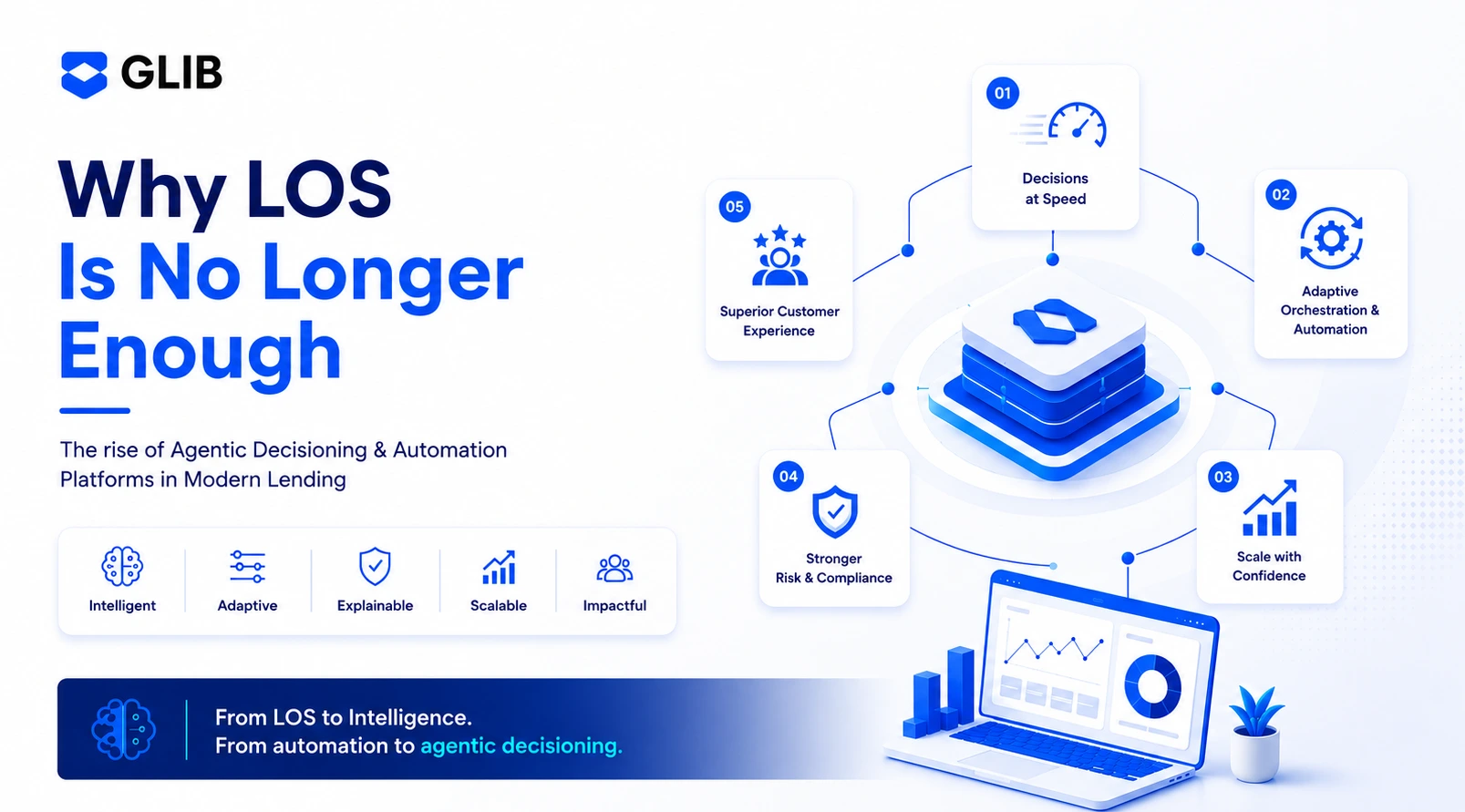
The future of lending will not be defined by who digitizes workflows fastest—but by who builds intelligent decisioning systems that can reason, adapt, and orchestrate operations in real time.
For more than two decades, Loan Origination Systems (LOS) have served as the operational backbone of lending institutions.
They helped lenders move away from paper-based operations, standardize workflows, improve process visibility, and bring structure to loan processing. In many ways, LOS platforms enabled the first generation of lending digitization.
However, the market has changed dramatically since these systems were originally designed.
Today’s lending environment is no longer defined solely by operational efficiency. It is increasingly shaped by:
- Real-time customer expectations
- Rising fraud sophistication
- Increasing compliance scrutiny
- Embedded finance
- Alternative data ecosystems
- Dynamic borrower behavior
- AI-driven financial crime
- Pressure to reduce turnaround times without increasing risk
This shift is exposing a critical limitation in traditional lending architectures.
Workflow automation alone is no longer sufficient.
Modern lenders now require systems capable of:
- Contextual reasoning
- Adaptive orchestration
- Continuous risk evaluation
- Real-time intelligence
- Explainable automation
- Dynamic compliance monitoring
This is why Agentic Decisioning & Automation Platforms are emerging as the next operational layer in lending.
Importantly, they are not replacing Loan Origination Systems—they are evolving the intelligence capabilities around them.
LOS Solved the Process Problem. Modern Lending Requires Solving the Intelligence Problem.
Traditional LOS platforms were built primarily to manage workflows.
Their architecture focuses on:
- Application intake
- Document collection
- Stage management
- Task routing
- Approval workflows
- Audit logging
- Operational coordination
This approach was highly effective when lending processes were relatively linear and predictable.
Today’s lending environment, however, is increasingly non-linear.
- Fraud patterns evolve continuously.
- Borrower financial profiles shift dynamically.
- Regulatory requirements change rapidly.
- Customer expectations demand instant decisions.
As a result, lenders are facing a new operational reality.
The bottleneck is no longer digitization. The bottleneck is intelligent decisioning.
Why AI Added on Top of LOS Is Still Not Enough
Many institutions initially respond to this challenge by layering AI tools on top of existing LOS platforms.
Examples include:
- OCR engines
- Fraud scoring tools
- Chatbot automation
- Risk models
- Document verification systems
- KYC automation
- Rule engines
These technologies improve isolated operational tasks.
Over time, however, this creates another problem.
Fragmented intelligence.
The institution itself becomes responsible for orchestrating:
- Disconnected AI tools
- Duplicated business logic
- Inconsistent decision-making
- Fragmented audit trails
- Siloed compliance checks
- Multiple risk systems
This often results in:
- Operational complexity
- Brittle integrations
- Governance gaps
- Slower adaptation
- Inconsistent customer experiences
In other words:
Adding AI features does not automatically create intelligent operations.
The Shift from Workflow-Centric Systems to Intelligence-Centric Systems
This is the fundamental industry transition now underway.
Traditional lending systems are workflow-centric.
Agentic Decisioning Platforms are intelligence-centric.
The difference is architectural.
A workflow-centric system assumes the process is predefined.
An intelligence-centric system assumes the system must continuously reason across changing context.
This distinction becomes critical in areas such as:
- Fraud detection
- Underwriting
- Customer onboarding
- AML monitoring
- Risk assessment
- Compliance orchestration
Modern lending operations increasingly require systems capable of:
- Correlating fragmented information
- Adapting workflows dynamically
- Escalating uncertainty intelligently
- Continuously monitoring risk
- Orchestrating decisions in real time
This is not traditional automation.
This is operational intelligence.
Why Cross-Document Intelligence Is Becoming Essential
Fraud detection illustrates this shift particularly well.
Traditional LOS systems typically perform:
- Rule-based validation
- Field matching
- Threshold checks
- Document completeness verification
Modern fraud rarely appears within a single document.
Instead, fraud increasingly emerges through:
- Cross-document inconsistencies
- Behavioral anomalies
- Transaction irregularities
- Synthetic identity patterns
- Contextual risk correlations
For example:
- A forged payslip may appear valid in isolation.
- A manipulated bank statement may satisfy predefined rules.
- A synthetic identity may pass standard KYC checks.
The fraud signal often becomes visible only when systems reason across:
- Multiple documents
- Behavioral data
- Financial intelligence
- Device signals
- Transaction history
- External data sources
This is where Agentic Decisioning Platforms become fundamentally different.
They do not simply validate information. They reason across it.
Lending Is Becoming a Real-Time Decisioning Environment
Historically, lending decisions were point-in-time events.
- An application was reviewed.
- A score was generated.
- A decision was made.
Modern lending increasingly requires:
Continuous decision intelligence.
Examples include:
- Continuous KYC
- Dynamic affordability monitoring
- Predictive delinquency analysis
- Adaptive fraud scoring
- Real-time onboarding decisions
- Portfolio-level risk monitoring
This changes the role of operational systems entirely.
The system is no longer expected to simply:
Process applications.
Instead, it must continuously:
- Interpret risk
- Monitor behavior
- Orchestrate actions
- Adapt workflows
- Explain decisions
- Escalate exceptions intelligently
This is the foundation of agentic operations.
Speed Alone Is Not the Competitive Advantage Anymore
For years, lenders focused heavily on reducing turnaround time (TAT).
Speed remains important.
However, speed without intelligence introduces risk.
The real competitive advantage now comes from balancing:
- Speed
- Accuracy
- Explainability
- Compliance
- Adaptability
Modern lenders must simultaneously:
- Accelerate onboarding
- Reduce fraud
- Maintain regulatory compliance
- Improve customer experience
- Scale operations efficiently
Achieving all of this is extremely difficult with static workflow systems alone.
Agentic Decisioning Platforms address this challenge by embedding:
- Intelligence
- Orchestration
- Governance
- Automation
directly into operational workflows.
Explainability Is Becoming a Strategic Requirement
Another major shift reshaping lending infrastructure is explainability.
As AI adoption increases, regulators and institutions are demanding:
- Transparent decision logic
- Auditability
- Governance visibility
- Human oversight
- Explainable automation
Traditional workflow systems were never designed around AI governance architectures.
Agentic platforms increasingly include:
- Explainable AI frameworks
- Confidence scoring
- Decision traceability
- Policy-aware orchestration
- Human-in-the-loop controls
These capabilities are becoming essential as lending decisions grow more AI-driven.
The Future of Lending Will Be Agentic
The next generation of lending operations will not be defined by isolated AI tools or incremental workflow improvements.
It will be defined by systems capable of:
- Reasoning across fragmented data
- Orchestrating dynamic workflows
- Adapting decisions continuously
- Embedding compliance natively
- Augmenting human judgment intelligently
This represents the shift from:
Automation → Intelligent Operational Infrastructure
Forward-looking lenders increasingly recognize that:
- Loan Origination Systems remain essential operational platforms.
- They are no longer sufficient as standalone decisioning architectures.
The future lending stack will increasingly consist of:
- Loan Origination Systems (LOS) for workflow management
- Agentic Decisioning & Automation Platforms for intelligence, orchestration, and adaptive automation
Together, they create a more scalable, intelligent, and resilient lending infrastructure.
Conclusion
The lending industry is entering a new operational era.
The challenge is no longer simply digitizing workflows.
The challenge is building systems capable of making faster, smarter, safer, and more explainable decisions at scale.
Traditional Loan Origination Systems solved the process problem.
Agentic Decisioning & Automation Platforms solve the intelligence problem.
As lending becomes increasingly real-time, adaptive, and AI-driven, this distinction will become one of the defining competitive advantages in financial services.
See Agentic Decisioning & Automation in Action
Ready to modernize your lending operations with intelligent decision orchestration?
Discover how GLIB helps financial institutions combine AI agents, workflow automation, and intelligent decisioning into a unified operational platform.