Even though customer onboarding in banking is mostly digital, many steps in the onboarding journey remain manual. Banks take hours to collect documents, verify identities, evaluate compliance, review financial information and resolve exceptions. Agentic AI is changing this with automated KYC, compliance and customer onboarding.
Instead of following predefined rules and workflows, agentic AI takes a different approach. It understands the context, makes decisions within guardrails, uses multiple data sources and orchestrates the next steps in the journey. This lets banks shift from traditional document processing and task automation to intelligent decisioning.
The Challenge with Traditional KYC and Onboarding
A customer onboarding journey involves many systems, multiple teams and different documents such as PAN card, Aadhaar card, passport, bank statements, income documents or business registration documents.
Once these documents are submitted, they need to be:
- Classified and validated
- Checked for completeness
- Cross-verified against application data
- Screened for potential fraud
- Evaluated against KYC and AML requirements
- Reviewed for exceptions
- Routed to the appropriate team
Traditional automation can handle these steps in isolation, but it struggles when it needs to understand incomplete documents, contradictory information or anything that requires contextual reasoning.
Agentic AI brings multiple systems, documents and teams together into one intelligent workflow.
How Agentic AI Automates KYC
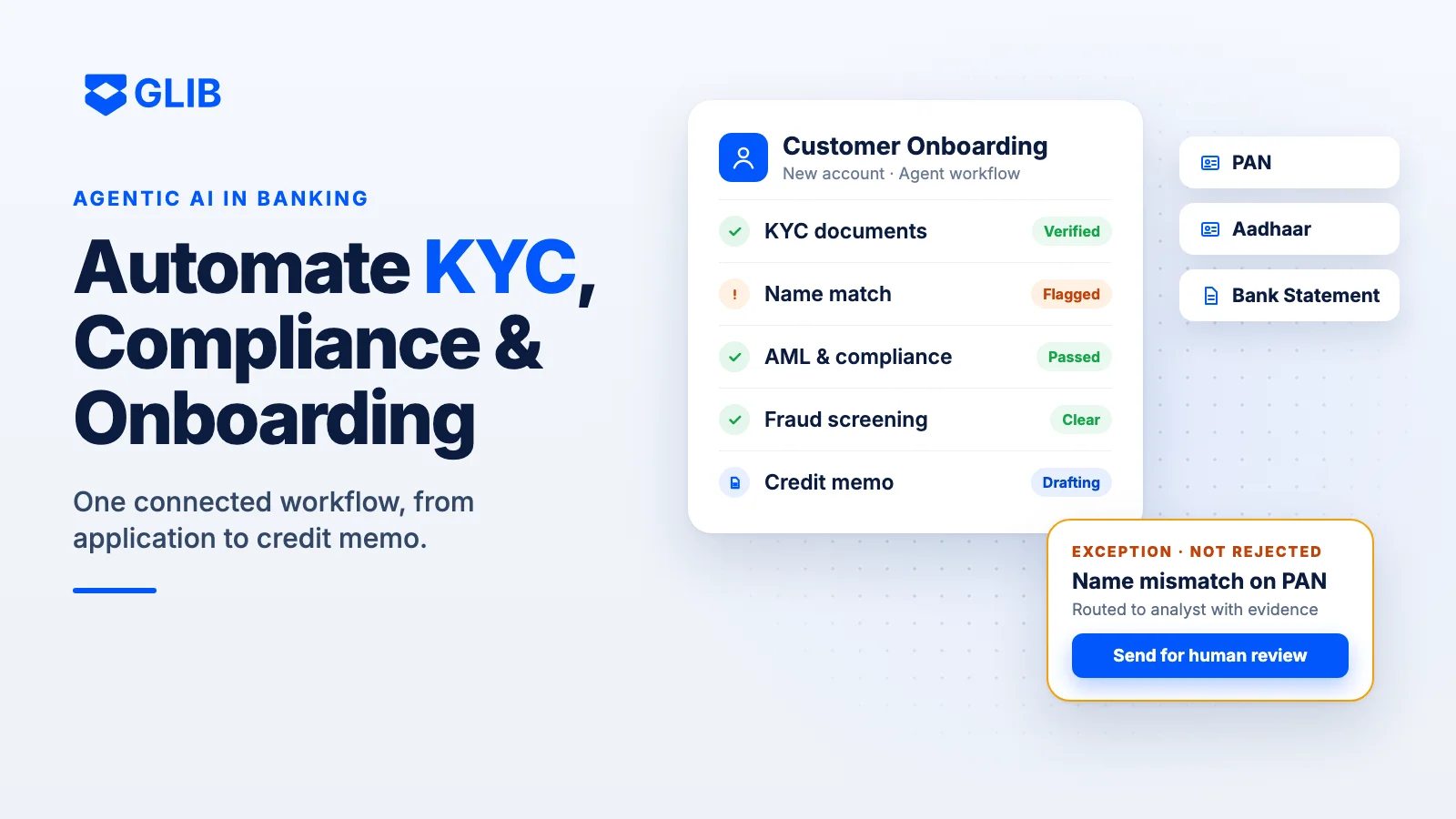
Agentic AI onboarding starts the moment a customer submits an application. It triggers a KYC agent to identify documents, extract the relevant information and check that the documents are sufficient. The agent then validates the documents across multiple systems and forms to find inconsistencies.
For example, if the customer’s name on a document does not match the name on the application, the KYC agent flags the mismatch instead of rejecting the application.
The agent does not stop there. It recommends next steps. If there are no discrepancies, it processes the application automatically. If there are, it routes the application for human review.
This lets employees focus on analysing exceptions rather than manually reviewing every application.
From Document Verification to Compliance Decisioning
Compliance is a multi-step activity that involves evaluating customer information against multiple regulatory and internal requirements. Agentic AI can orchestrate these checks by bringing them into a single workflow.
Once an agent extracts identity-related information, it initiates verification checks, analyses the documents against predefined requirements and flags exceptions.
What differentiates agentic AI is that it can be supervised wherever required, especially at decision points. Banks can configure rules, approval limits and human-in-the-loop controls to put the right guardrails in place, combining AI-driven efficiency with regulatory governance.
Detecting Fraud During Onboarding
Fraud detection is another significant area for agentic AI. Not every document that looks clean is clean. Documents submitted during onboarding can contain manipulated information, inconsistent patterns and discrepancies that basic validation may miss.
AI can flag suspicious transaction patterns and discrepancies in financial documents, strengthening fraud detection in bank statements by identifying suspicious patterns before the application is processed. An agent brings together information from different data sources and multiple documents instead of evaluating each document on its own. For example, it can identify inconsistencies by comparing declared income with the bank statement and financial statements.
This is how agentic AI reduces the manual effort of operations and credit teams, making fraud and risk detection more effective through contextual reasoning.
Connecting Onboarding with Credit Underwriting
Once customer verification is complete, KYC and onboarding automation need to connect with the credit process. The same AI-driven workflow carries the application into credit assessment, where lenders can automate financial data extraction, income assessment, bank statement analysis, eligibility validation and risk evaluation.
An agentic AI platform carries verified information to each stage of the customer journey, so the same information is not collected and reviewed again and again. The result is a connected end-to-end lending workflow, from application and KYC to underwriting and decisioning.
Automating Credit Memos and Decision Documentation
Next comes the credit memo. Credit teams spend significant time preparing documentation to support lending decisions. A structured credit assessment draws on application forms, financial statements, bank statements, bureau reports and more.
AI-powered credit memo automation software can consolidate this information into structured credit memos by applying predefined templates, policies and approval requirements. Agentic AI can orchestrate the entire process: identifying the information the memo needs, retrieving it from the relevant sources, flagging exceptions and generating a draft for the credit officer.
The Future of Banking Onboarding Is Intelligent Orchestration
Banks will not transform by removing humans from their processes. They will transform by empowering people with intelligent systems that automate repetitive tasks in context and escalate decisions within human governance.
Agentic AI modernizes banking by bringing KYC, compliance, fraud detection, document intelligence, underwriting and customer onboarding together into one connected workflow.