Ask a lending team whether AI agents can replace credit analysts, and you will probably hear one of two answers. One says yes, soon. The other says never, because credit is a judgment business.
The more useful question is narrower: on any given file, which parts are preparation and which parts are judgment?
Preparation is being automated quickly. Judgment is not. And that changes the shape of the analyst’s job.
What AI Agents Already Do Well
On a standard retail or MSME file, much of the analyst’s time goes into assembling the case rather than assessing it.
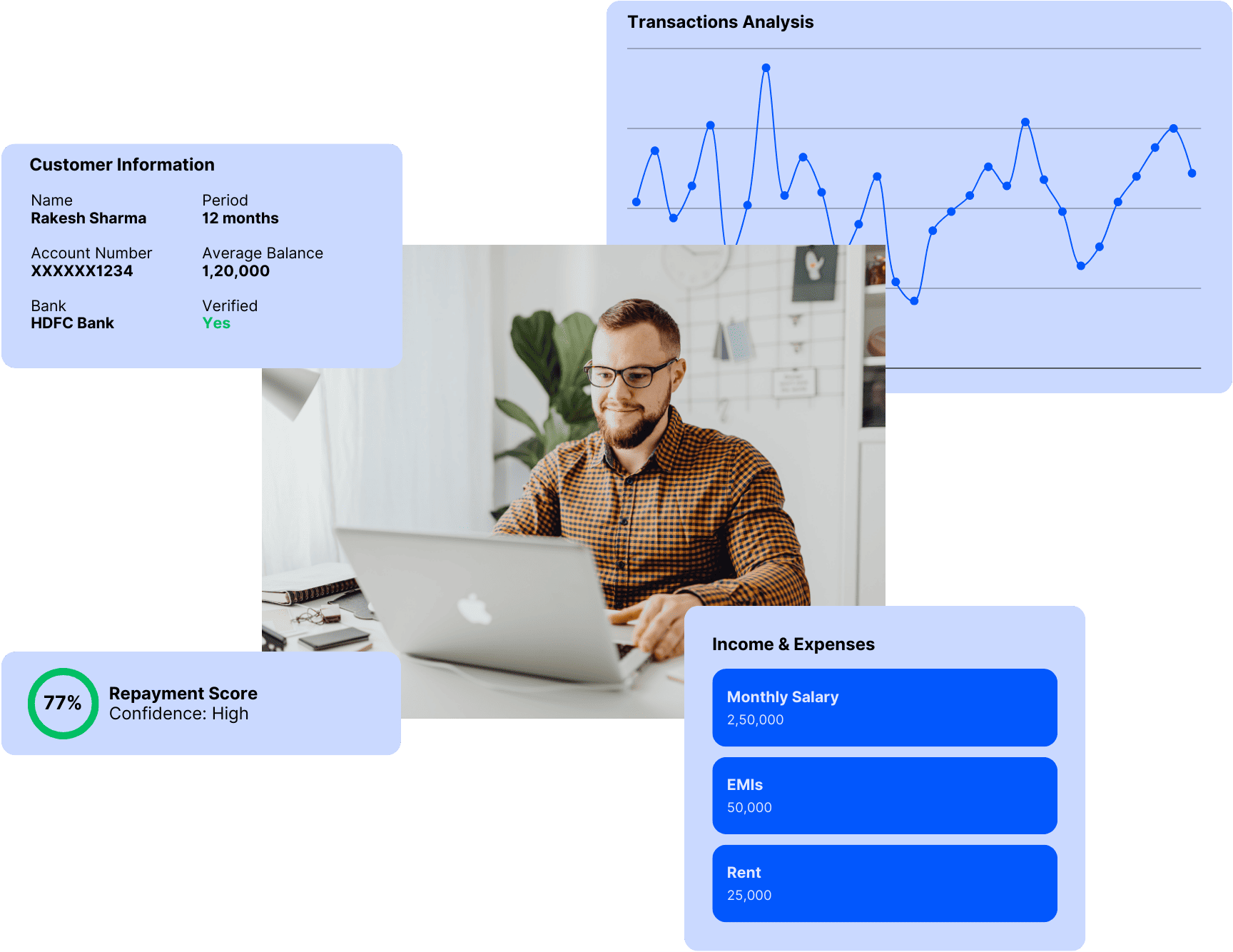
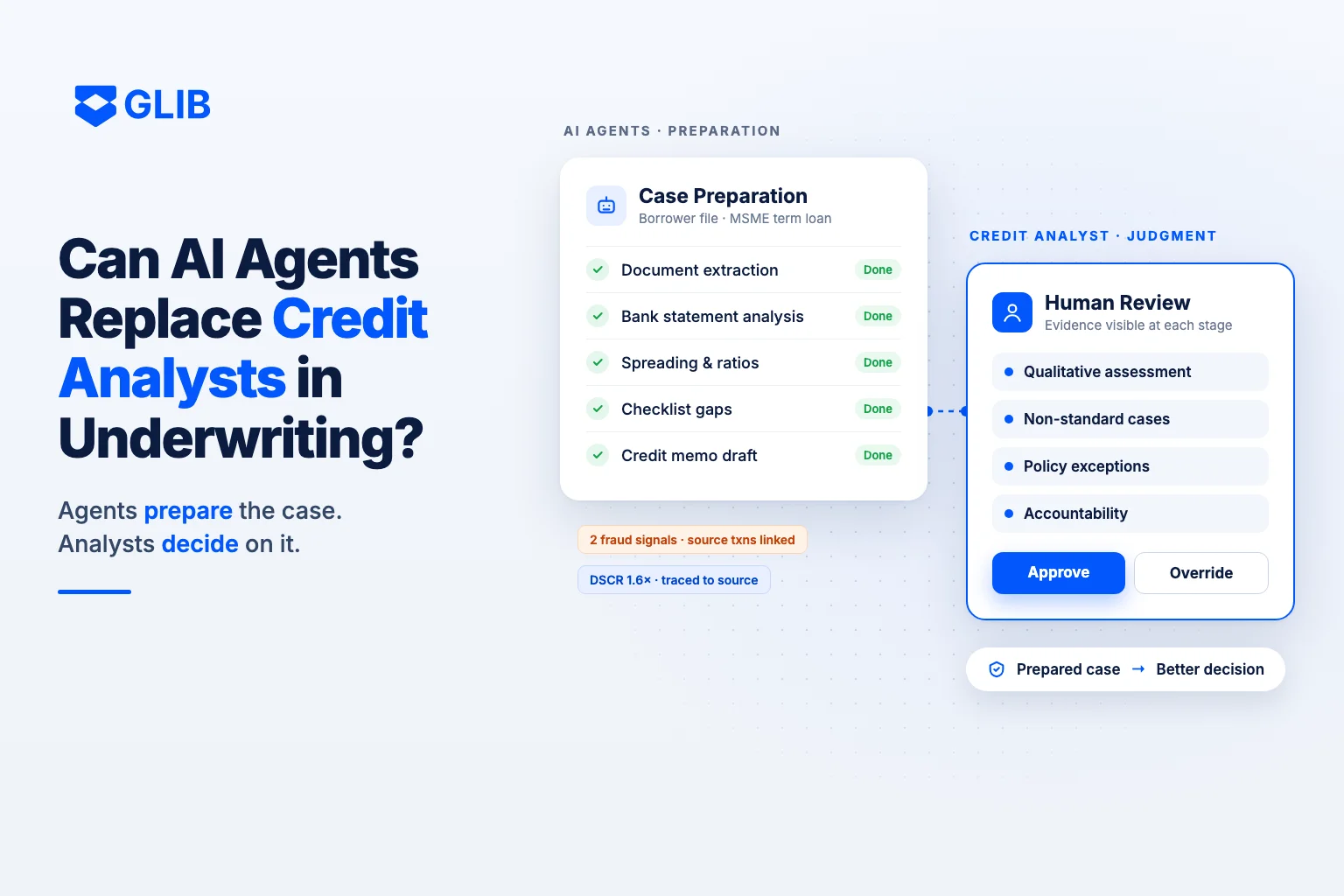
Agents handle that part now. One reads statements, payslips, ITR, and GST filings and extracts the fields. Another runs bank statement analysis for loan approval: categorizing transactions, verifying income, identifying existing obligations and surfacing fraud signals with the transactions behind them. Another spreads financials and computes ratios against the lender’s own thresholds. Another checks the file against the product checklist, separates blocking gaps from non-blocking ones and requests what is missing. Another drafts the Credit Appraisal Memo from the evidence already gathered.
None of this is judgment. It is reading, structuring, calculating and drafting, done consistently on every file rather than carefully on some and hurriedly on others at month-end.
Where the Human Analyst Stays
Four parts of underwriting do not transfer.
Qualitative assessment. Can the business owner keep the business running through a difficult year? Is the slowdown in the industry temporary? Is a strong client relationship worth considering even if the numbers alone don’t support the decision? These are things you can’t always understand from documents alone.
Non-standard cases. Restructuring, distressed borrowers, unusual security and bespoke covenants. Models work best when there is a pattern to follow. These are the files where there often isn’t one.
Exceptions. The deal that fails policy on one parameter but is sound overall is exactly the kind of case automation should escalate rather than decide.
Accountability. When a sanction is questioned by a credit committee, an auditor or a regulator, someone has to explain the reasoning. A confidence score is not an explanation.
Why Hallucination Keeps the Human in the Loop
There is a practical reason beyond philosophy. Language models are built to produce plausible output, which becomes a problem when that output is a DSCR or a verified income figure.
A workable design separates the two jobs. Numbers, extractions and risk scores should come from reliable, traceable processing, with every figure tied back to the line in the document it came from. Language models can then handle summarization and narrative, working from those grounded figures rather than generating the underlying numbers themselves.
That is what human-in-the-loop means in practice. Not a person rubber-stamping AI output, but a review point after each stage where the evidence is visible and can be overridden.
What Actually Changes for the Analyst
The job does not disappear. It just changes.
An analyst who once spent a large part of the day on data entry, financial spreading, and checklist follow-ups can now start with a prepared case. The AI agent has already completed the spread, calculated the ratios, flagged potential fraud with the source transactions, and drafted the memo.
The analyst can then spend more time on what actually needs their experience: reviewing the case, understanding the risks, and making the right decision.
It also means teams can handle more files without having to increase the team at the same rate. And when the routine work is automated, the quality of the initial review is less affected by how busy the team is.
GLIB Bank Statement Analyzer
GLIB’s AI Bank Statement Analyzer is designed for Indian lenders. It uses built-in OCR to read e-statements, scanned statements, passbooks, and photos taken on a phone. It can also fetch bank statements directly through Account Aggregator journeys.
It reviews multiple bank accounts together, checks income, groups expenses, tracks cash flow, and compares bank statements with credit bureau reports, payslips, ITRs, and GST returns. It also flags warning signs such as altered documents, unusual income deposits, and cheque bounces. These cases are sent for human review with the relevant transactions, so the credit officer can examine the evidence and make the final decision.
Reports can be customized or drawn from templates for retail, SME, home, auto, and 20+ other loan products, and delivered through APIs in Excel, JSON or XML. GLIB has processed over 10 million documents and saved more than 1.2 million man-hours for institutions including ICICI Bank, Bank of Baroda, TATA Capital and Bandhan Bank.
So, Can They Replace Analysts?
No, and lenders getting the most out of agentic AI are not trying to.
They are using it to remove the preparation layer, so analysts can spend their time on the files and questions that actually need them.
For a credit team evaluating an AI bank statement analyzer in India, the standard is not whether it can make the decision. It is whether it can hand the analyst a better case to decide on.
Want to see what your team can stop doing manually?
Book a demo today.