A loan decision can be made in minutes and still be hard to defend months later.
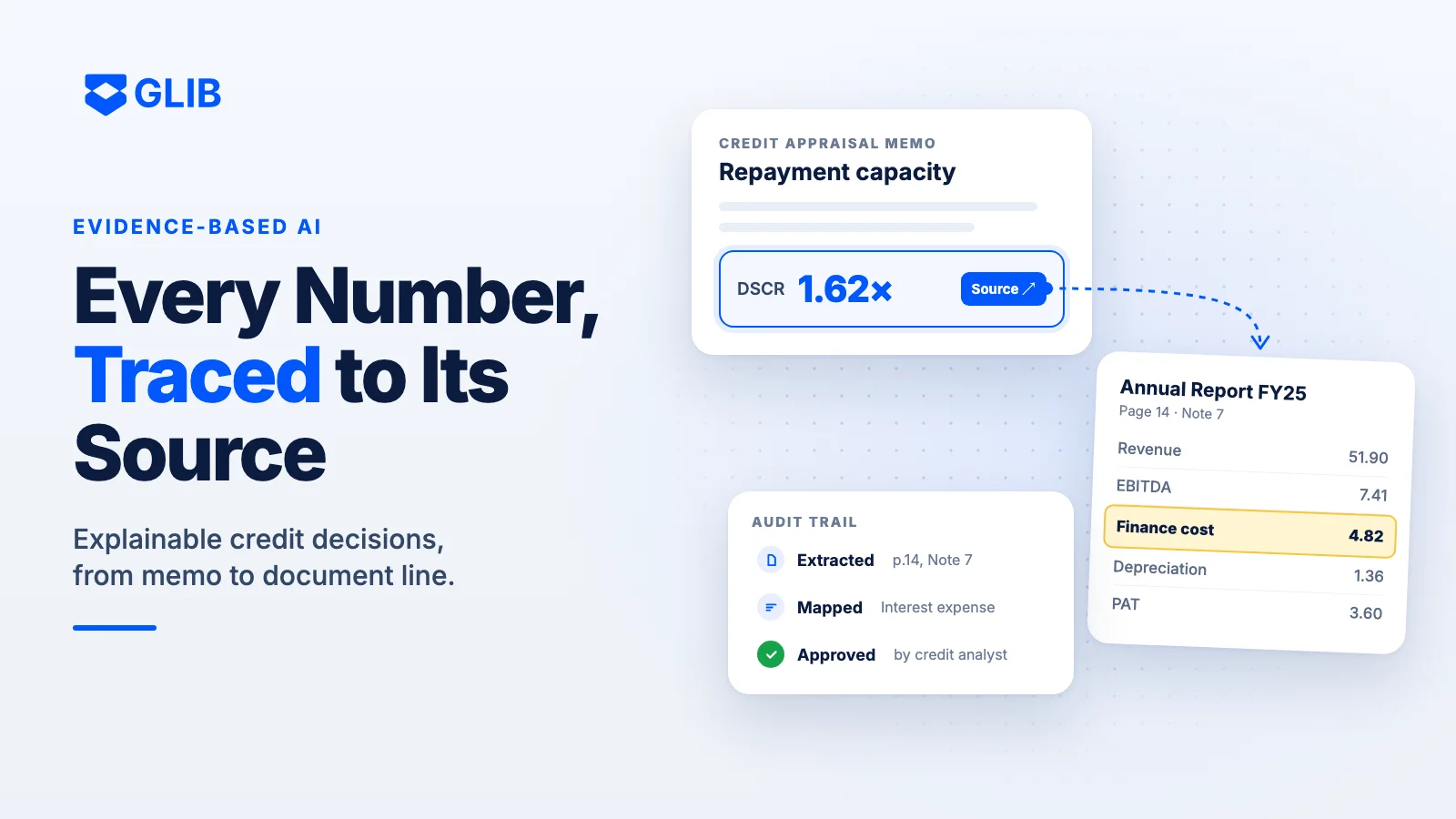
The test comes when an auditor or a credit committee points to a number in the credit memo and asks where it came from. If the answer is that the system produced it, that is a problem. If the answer is page 14 of the annual report, note 7, approved by a named analyst, the question is settled.
That is the idea behind evidence-based AI. Every number it produces stays linked to the document line it came from.
What Explainable AI Means in Lending
Explainable AI usually refers to model logic: which factors the scorecard used and how much each one mattered.
But lenders also need answers to some basic questions about the numbers in a report: Where did a figure come from? How was it classified? How was it used? Who checked it?
Evidence-based AI helps answer these questions by keeping a record of the source and use of each figure.
How an Evidence Chain Works
In a spreading workflow, the trail has six steps, and each one should be reversible.
A number appears in the credit memo. It came from a ratio. The ratio came from specific line items. Each line item was mapped to a head in the lender’s chart of accounts. Each mapping came from an extracted value, and that value came from a page, a table and a row in the original statement.
If any step is missing, the explanation stops there. A spread with no path back to the document is a number the lender is asked to trust.
Why Intelligent Document Processing for Banks Decides This
Intelligent document processing for banks is usually judged on speed. It should also be judged on evidence.
If a figure is pulled from a scanned annual report and nobody records which page it came from, nothing after that point can be fully explained, however clear the scoring logic is.
The same applies when the system is unsure about a value. A low-confidence figure that is quietly filled in becomes an unexplained number in the memo. The same figure sent to an analyst becomes a documented decision.
Good extraction is the base of financial spreading automation, not a step to rush before the real analysis starts.
How Agentic AI for Lending Builds the Audit Trail
Audit trails are often prepared after the work is done. This can leave gaps in the records.
Agentic AI for lending takes a different approach. As different agents handle tasks such as reading documents, mapping figures, calculating ratios, comparing results, and drafting memos, each step is recorded. The system keeps track of what information it used, what it calculated, which rules it followed, what the analyst changed and when.
Analysts still review the work. They can check the source behind a classification, approve it, correct it, or flag it for further review. Every change is recorded, including who made it.
Why Lenders Are Now Asking About This
Getting an answer quickly is only useful if the lender can check how the system reached it. If an analyst still has to go back through the original documents to verify the figures, much of the time saved is lost.
Lenders also need to show how they reviewed and assessed each loan application. Without a clear record of the process, it becomes harder to explain and support credit decisions.
That is why lenders are asking how AI systems record their work, not just how accurate their results are.
GLIB Financial Statement Analyzer
GLIB’s Financial Statement Analyzer follows this approach. It uses agentic AI to turn balance sheets, P&L accounts and cash flow statements into spreads, ratios, scorecards, risk assessments and credit memos. It also picks up figures from notes and schedules, not just the main statements.
The system matches each line item to the lender’s chart of accounts. It uses the lender’s existing credit policy for calculations, checks and scoring. It then drafts memos based on the financial spread, so the written assessment reflects the actual figures.
Human-in-the-loop controls let analysts review, correct and approve the output before it is finalized. REST APIs and webhooks also allow the results to flow into loan origination and credit decisioning systems.
GLIB has processed over 10 million documents and saved more than 1.2 million man-hours for institutions including ICICI Bank, Bank of Baroda, TATA Capital and Bandhan Bank.
Faster Decisions That Hold Up
Speed and explainability do not have to work against each other. In document-based credit assessment, both depend on having a clear record of the information used, the calculations made and the decisions taken.
A Few Things to Know
What is evidence-based AI in lending?
It is AI that connects each result to the original source document, making it easy to trace and verify the figures used in a credit memo.
How is it different from explainable AI?
Explainable AI usually describes how a model weighed its inputs. Evidence-based AI shows where each number came from and who approved it.
Does a financial statement analyzer replace the credit analyst?
No. It prepares the spread, ratios and memo draft. The analyst reviews, overrides and approves.
Want to see what an auditable spreading workflow looks like on your own files?
Book a demo today.